Visualizzazione post con etichetta tempio. Mostra tutti i post

giovedì 4 novembre 2021

WAT LUANG KHUN WIN - IL TEMPIO NASCOSTO - THE HIDDEN TEMPLE


[ASCOLTA SU SPOTIFY]

[SCROLL DOWN FOR ENGLISH]

Nella foresta, sulla montagna di mae win, c'è una radura dove si è soffermato anche il Buddha, probabilmente anche lui incantato dalla bellezza del luogo. Qui ha incontrato due devoti lawa, Khun Sap e Khun Srameng che gli chiesero di lasciare la sua impronta. Il Buddha acconsentì, ma la pietra che avrebbe dovuto ricevere tale segno risultò essere troppo piccola, il tallone e le dita non rimasero impresse. A questo punto fu chiesto al Buddha di lasciare qualche capello come reliquia. Buddha consegnò allora nelle mani dei due devoti cinque capelli. Per conservare questa importante reliquia venne costruito un chedi. 


Tutto questo accadeva circa 700 anni fa. Da allora il tempio in mezzo alla foresta ha avuto periodi prosperità e lunghi anni di abbandono. Purtroppo si è persa anche gran parte della documentazione storica. Il tempio è stato ampliato e negli anni ha subito diversi rimaneggiamenti. L'ultima fase di restauro e di rivitalizzazione è iniziata nel 1954 grazie a Baun Ruen Suphatto, insegnante del Wat Kuannimit del distretto di San Pa Tong. 


La posizione estremamente isolata nel cuore della foresta contribuisce a mantenere intatto il fascino del tempio, inteso nel suo significato letterale di capacità di attrazione, anche per la sua atmosfera magica.  Sono venuta a conoscenza dell'esistenza del Wat Luang Khun Win almeno tre anni fa, osservando Google maps. Mi aveva colpito che un tempio caratterizzato dal denominativo "Luang", proprio dei templi con patrocinio reale, si trovasse in un luogo tanto sperduto e fosse sconosciuto ai più. Nonostante la curiosità fosse tanta, ho dovuto attendere a lungo prima a causa della stagione non propizia, poi per la chiusura a causa della pandemia e infine per l'incidente che mi ha messo fuori gioco per molti mesi. In realtà un tentativo lo avevo fatto insieme ad altri amici a luglio del 2020, cercando di passare però da un percorso troppo impervio. Potete trovare il racconto a questo link. 

Infine ci sono arrivata passando da mae win, arrivando in motorino fino al Karen Eco Lodge, poi da qui ho dovuto arrendermi e accettare di proseguire in song teaw. Le piogge abbondanti e una forma fisica ben lontana da quella del precedente tentativo mi hanno convinto che non fosse il caso di fare tentativi né in motorino né a piedi. Su consiglio della titolare del resort siamo partite la mattina alle 08:00, per percorrere 10 chilometri il song teaw impiega circa un'ora tra salite e discese su strada in molte parti sterrata. Quando siamo arrivate il cancello era ancora chiuso e il nostro autista è sceso ad aprire. 

Quando si agogna tanto tempo poter visitare un luogo il rischio di rimanerne delusi è alto, non perchè il posto sia effettivamente meno bello ma perché lo si è caricato di troppe aspettative...ma in Thailandia questo non accade. L'emozione per tanta bellezza in mezzo alla foresta è stata davvero tanta. Dopo la pioggia abbondante della notte, il cielo è rimasto nuvoloso e a tratti concede schiarite che illuminano il prato che circonda gli edifici del tempio.


Il chedi, recentemente restaurato appare di un bianco che stacca nettamente dal verde dell'erba e degli alberi, ma anche dal marrone del legno delle costruzioni. Gli edifici sono tutti di dimensioni modeste, tutti in legno di teak e in quello più in alto è collocato uno straordinario Buddha in piedi, alto almeno sei metri, ricavato da un unico tronco di teak.


L'espressione del volto è insolita, non sorridente, i piedi sono uno davanti all'altro e quello arretrato è parzialmente sollevato, ma le mani non sono nella classica posizione del Buddha che cammina, bensì incrociate in basso, una sull'altra.


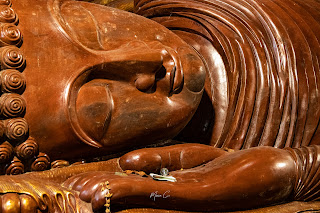
Nel complesso una immagine seriosa e solenne. Purtroppo non sono riuscita a trovare informazioni in merito all'autore o all'epoca. Di fronte vi è un edificio più piccolo, dove è collocata una statua del Buddha sdraiato, sempre in legno, di fattura sicuramente recente, il colore del legno è più chiaro rispetto all'altra statua. La parete alle spalle del Buddha sdraiato e la controfacciata sono interamente ricoperte da bassorilievi in legno che rappresentano uomini e animali che venerano Buddha. 


Da segnalare anche l'elegante scalinata che immette al prato dove sono collocati gli edifici. I due naga sono imponenti e molto eleganti, i lunghi corpi attraversano elementi ornamentali sempre di colore bianco. I gradoni di accesso di forma semicircolare ricordano anch'essi le squame della pelle dei draghi.


Non so dire quanto tempo abbiamo trascorso immerse in tanta bellezza, sicuramente il Wat Luang Khun Win ha il potere di farti sentire nostalgia ancora prima di ripartire. 

L'autista e Elide, compagna di avventura


[ENGLISH VERSION]


In the forest, on the mountain of mae win, there is a clearing where Buddha also stopped, probably enchanted by the beauty of the place. Here he met two lawa devotees, Khun Sap and Khun Srameng, who asked him to leave his footprint. The Buddha agreed, but the stone that should have received this footprint turned out to be too small, the heel and fingers did not remain impressed. At this point the Buddha was asked to leave some hair as a relic. Buddha then delivered five hairs into the hands of the two devotees. A chedi was built to preserve this important relic.


All this happened about 700 years ago. Since then the temple in the middle of the forest has had periods of prosperity and long years of neglect. Unfortunately, much of the historical documentation has also been lost. The temple has been enlarged and over the years has undergone several alterations. The last phase of restoration and revitalisation began in 1954 thanks to Baun Ruen Suphatto, a teacher at Wat Kuannimit in the San Pa Tong district. 

The extremely isolated location in the heart of the forest helps to maintain the temple's charm, understood in its literal meaning of attractiveness, also because of its magical atmosphere.  I became aware of the existence of Wat Luang Khun Win at least three years ago, looking at Google maps. I was struck by the fact that a temple with the name 'Luang', typical of temples with royal patronage, was in such a remote location and unknown to most people. Although my curiosity was piqued, I had to wait a long time, first because of the unfavourable season, then because of the closure due to the pandemic, and finally because of the accident that put me out of action for many months. In fact, I had made an attempt with other friends in July 2020, but tried to get through a route that was too difficult. You can find the story at this link. 

I finally got there via mae win, arriving by motorbike to the Karen Eco Lodge, then from here I had to give up and accept to continue by song teaw. The heavy rains and a physical shape far from that of the previous attempt convinced me that it was not the case to make attempts either by moped or on foot. On the advice of the owner of the resort we left in the morning at 08:00, to cover 10 kilometres the song teaw takes about an hour between ascents and descents on a road in many parts unpaved. When we arrived the gate was still closed and our driver went down to open it. 

When you yearn for so long to visit a place the risk of being disappointed is high, not because the place is actually less beautiful but because you have loaded it with too many expectations ... but in Thailand this does not happen. The emotion for such beauty in the middle of the forest was really great. After the abundant rain during the night, the sky remained cloudy and at times it cleared up, illuminating the lawn surrounding the temple buildings.


The recently restored chedi is white and stands out clearly against the green of the grass and trees and the brown wood of the buildings. The buildings are all modest in size, all made of teak wood, and in the highest one stands an extraordinary standing Buddha, at least six metres high, carved from a single teak trunk. The facial expression is unusual, not smiling, the feet are in front of each other and the back one is partially raised, but the hands are not in the classic walking Buddha position, but crossed below, one on top of the other. All in all a serious and solemn image.

Unfortunately I have not been able to find any information about the author or the time. Opposite there is a smaller building, where there is a statue of the reclining Buddha, also made of wood, certainly of recent manufacture, the colour of the wood is lighter than the other statue. The wall behind the reclining Buddha and the counter-façade are entirely covered with wooden bas-reliefs depicting men and animals worshipping Buddha. 

There is also an elegant staircase leading to the lawn where the buildings are located. The two nagas are imposing and very elegant, their long bodies crossing white ornamental elements. The semi-circular access steps are also reminiscent of the scales on a dragon's skin. 


I can not say how much time we spent immersed in such beauty, certainly Wat Luang Khun Win has the power to make you feel nostalgic even before leaving. 


martedì 21 settembre 2021

PICCOLI GIOIELLI A MAE RIM - SMALL JEWELS IN MAE RIM


[SCROLL DOWN FOR ENGLISH]

Le mie ultime vacanze risalgono al capodanno 2019/2020, poi la pandemia e un incidente hanno fatto sì che a parte un paio di fine settimana dedicati a delle gite, io non ho più fatto vacanze. Sentivo quindi la necessità di ricaricarmi, ma dato che la Thailandia è ancora soggetta a molte restrizioni e che la situazione può variare da un momento all'altro ho preferito non allontanarmi da Chiang Mai.

Andare a trascorrere un fine settimana lungo a venti chilometri da casa a qualcuno può sembrare una scelta ridicola, invece ha funzionato alla grande. I dintorni di Chiang Mai sono bellissimi e tra montagne e campi di riso si possono scoprire dei piccoli gioielli. Uno di questi è senz'altro il Country Retreat a mae rim. Un resort di piccole dimensioni in mezzo a verdissimi campi di riso, con un giardino molto curato e una piscina che favorisce l'assoluto relax, con di fianco un bar che in questi giorni rimane inutilizzato a causa delle prescrizioni sulla vendita di alcol.


Dalla piscina si accede ad un comodissimo "sala" al centro di un campo di riso con comode sedute e amache.


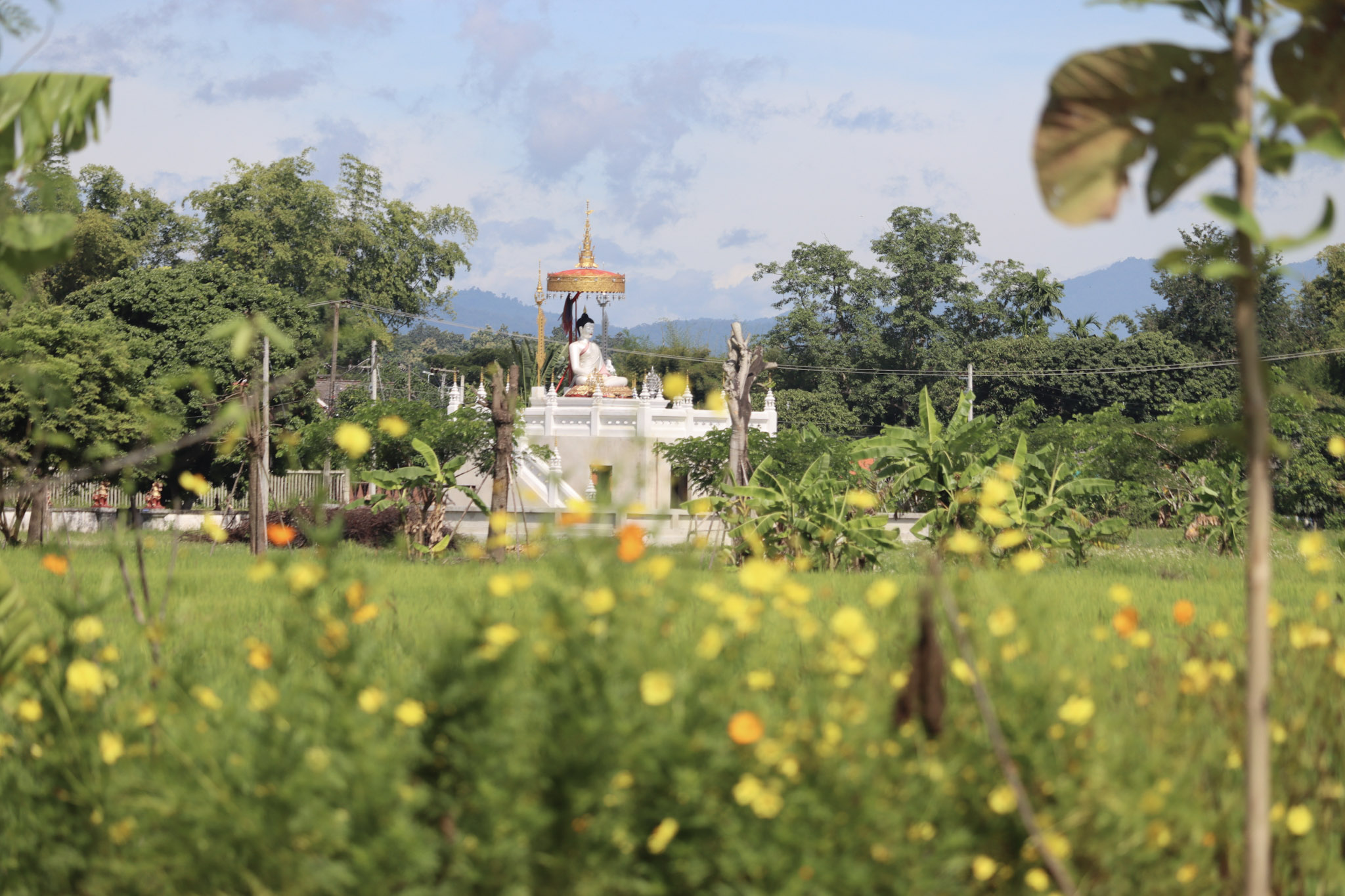
La vista può spaziare fino alle montagne intorno, in alcuni momenti il cielo è già molto limpido tra una pioggia e l'altra. Ad abbellire il panorama un piccolo tempio di campagna, con una statua di Budda che sembra galleggiare sopra le spighe del riso.


Con la luce notturna è molto suggestivo e la mattina all'alba il canto dei monaci dona al tutto un'atmosfera fiabesca, insieme ai suoni di coloratissime nectarinie e uccellini vari.

Un evento eccezionale che può accadervi al Country Retreat prima di andare a dormire è vedere le lucciole, la loro scomparsa è stato uno degli eventi che ha simbolicamente segnato il declino delle civiltà moderne incapaci di contenere l'inquinamento, come denunciato a suo tempo dal profetico intellettuale italiano Pier Paolo Pasolini. 

Io sono arrivata il venerdì nel primo pomeriggio, ho trascorso gran parte del pomeriggio nella piscina, abbastanza grande da poter fare qualche bracciata, con anche delle bocchette per idromassaggio e una temperatura dell'acqua assolutamente gradevole. 


Il sabato mattina sono stata raggiunta da tre amiche e dopo un po' di polleggio nel ristornate abbiamo (hanno) noleggiato le biciclette e siamo (io in motorino) andate a fare un giro. La nostra meta era l'Erotic Garden che è a meno di un chilometro di distanza ma lo abbiamo trovato chiuso, ci siamo quindi dirette al tempio e poi è iniziata una faticosa ricerca di un posto dove mangiare. L'unico che abbiamo trovato ha soddisfatto però solo due di noi in quanto serve solo noodles con carne. Qui un signore già avanti con gli anni con molta emozione è venuto a servirci utilizzando le sue nozioni di inglese. Una volta tornate al resort due delle amiche sono ripartite mentre una terza è rimasta. Abbiamo quindi proseguito il pomeriggio in piscina, osservando il monsone che si avvicinava, per poi oltrepassarci, mentre i colori intorno cambiavano continuamente le loro sfumature, grazie anche alla luce del tramonto. 

Il ristorante del resort merita sicuramente, cucina thai, preparata al momento, nulla di precotto, ingredienti freschi e molti di produzione propria. 

La coppia di padroni di casa è molto socievole e attentissima ad ogni esigenza degli ospiti.


Non mancano due dolcissimi cani e un maiale che crede di essere un cane. 


[ENGLISH VERSION]

 My last holidays date back to New Year's Eve 2019/2020, then the pandemic and an accident meant that apart from a couple of weekends dedicated to trips, I didn't take any more holidays. I therefore felt the need to recharge, but as Thailand is still subject to many restrictions and the situation can change from one moment to the next I preferred not to stray far from Chiang Mai.

Spending a long weekend twenty kilometres from home may seem ridiculous to some, but it worked out great. The surroundings of Chiang Mai are beautiful and between mountains and rice fields you can discover little gems. One of these is undoubtedly the Country Retreat in Mae Rim. A small resort in the middle of green rice fields, with a well-kept garden and a swimming pool that encourages absolute relaxation, with a bar next to it, which these days remains unused due to regulations on the sale of alcohol. From the pool there is access to a very comfortable "sala" in the middle of a rice field with comfortable seating and hammocks. The view extends as far as the surrounding mountains, and at times the sky is already very clear between one rain and another. The view is enhanced by a small country temple with a Buddha statue that seems to float above the ears of rice. In the night light it is very impressive and in the morning at dawn the singing of the monks gives the whole place a fairy-tale atmosphere, together with the sounds of colourful nectarinias and various birds.

An exceptional event that can happen to you at the Country Retreat before going to sleep is to see the fireflies, their disappearance was one of the events that symbolically marked the decline of modern civilizations unable to contain pollution, as denounced in his time by the prophetic Italian intellectual Pier Paolo Pasolini. 

I arrived on Friday in the early afternoon and spent most of the afternoon in the pool, which was big enough to take a few strokes in, with hydromassage jets and an absolutely pleasant water temperature. 

On Saturday morning I was joined by three friends and after a bit of lounging in the restaurant we (they) rented bikes and went for a ride. Our destination was the Erotic Garden which is less than a kilometre away but we found it closed, so we headed to the temple and then began a laborious search for a place to eat. The only one we found satisfied only two of us as it only serves noodles with meat. Here a gentleman who was already well advanced in years came to serve us with great emotion using his knowledge of English. Once back at the resort two of our friends left and a third stayed. We have therefore continued the afternoon in the swimming pool, observing the monsoon that was approaching, to then pass us, while the colours around continually changed their shadings, thanks also to the light of the sunset. 

The restaurant of the resort deserves for sure, thai cuisine, prepared at the moment, nothing precooked, fresh ingredients and many of own production. 

The couple of hosts are very sociable and attentive to every need of the guests. There are also two very sweet dogs and a pig who thinks he is a dog. 


mercoledì 2 dicembre 2020

WAT PHRATHAT PHA SORN KEAW - un tempio di straordinaria bellezza - a temple of extraordinary beauty


[SCROLL DOWN FOR ENGLISH]

 ...come prima meta, dopo questo lungo periodo di fermo forzato, ho scelto un tempio la cui immagine è abbastanza diffusa e conosciuta, mentre il luogo rimane non frequentato dai turisti stranieri e relativamente poco anche dai thai. 

Il Wat Prhathat Pha Sorn Keaw sorge in cima ad un colle, a 840 metri sul livello del mare, in mezzo alle montagne nei pressi dell'abitato di Khaem Som, lungo la strada che collega Phitsanulok a Petchabun. La zona viene anche chiamata "la Svizzera della Thailandia" proprio per il paesaggio montano e, tra l'altro, proprio nei pressi del tempio potrete mangiare in un'autentica baita svizzera.  La zona negli anni ha visto proliferare l'offerta alberghiera ma per qualche strano motivo è praticamente assente un servizio di trasporto pubblico e quasi inesistente quello privato. Ma cominciamo dall'inizio. Da Chiang Mai per raggiungere il luogo più prossimo al tempio il mezzo migliore è l'autobus e la tratta è Chiang Mai - Lom Sak. Su indicazione del personale dell'albergo dove ho prenotato abbiamo chiesto di scendere al Hue Pai Market e comunque il personale del bus non riusciva a capire e ho mostrato loro la foto del tempio. Di fatto non si tratta di una fermata, ma di un favore che vi fanno, risparmiandovi il dover trovare poi un transfer da Lom Sak a Khaem Som. Quest'ultimo è un centro abitato o meglio un gruppo di costruzioni lungo la strada che collega Phitsanulok a Petchabun. Il tempio è a circa due chilometri, ben visibile dalla strada, per vostra fortuna, perchè incredibilmente manca qualsiasi segnaletica che vi indichi la direzione per raggiungerlo. Per il resto, nel caso abbiate la fortuna di avere una camera con vista verso la montagna, l'atmosfera è davvero piacevole, l'aria molto fresca e pulita e vedere a distanza il tempio illuminato è davvero suggestivo. 


La mattina abbastanza presto ci siamo rivolti alla reception per avere indicazioni per raggiungere il tempio. La giovane incaricata non parla inglese e si destreggia con Google translator per comunicarci che l'unica modalità è noleggiare una moto o un'auto. Chiediamo quanto costa affittare un'auto con autista e dopo varie telefonate ci informa che la richiesta è di 500 bhat solo andata. La cifra ci sembra davvero esagerata per meno di due chilometri, tanto che decidiamo di avviarci a piedi. Mentre camminiamo veniamo superati da diversi Song-Teaw, i classici furgoni scoperti con il retro adibito al trasporto passeggeri, proviamo a fermarli e al terzo tentativo riusciamo a farci caricare. All'arrivo l'autista rifiuta di essere pagato, sorridendo, non posso fare a meno di sfoggiare il mio thai per benedirlo. 


Il wat phrathat pha sorn keaw è un monastero e centro di meditazione di recente costruzione, la fondazione è del 2004. Nonostante abbia fatto diverse ricerche non sono riuscita a risalire al nominativo dell'autore del visionario progetto. Come ogni tempio thailandese anche questo è composto da vari edifici e strutture con diverse finalità. Il più spettacolare è formato dalla scultura raffigurante i cinque buddha seduti, nella posizione della meditazione, in fila dal più piccolo al più grande. Lungo le scalinate di accesso sono posizionate delle sculture in metallo, che formano cerchi concentrici, dove sono collocate delle sfere di acciaio, una rappresentazione forse dell'universo o comunque con un richiamo al cosmo. 


La pavimentazione della terrazza antistante presenta vari mosaici, purtroppo la presenza di molti devoti non consente una visione completa del disegno.


La base di questa incredibile opera è su due piani e contiene due sale per la preghiera. Una delle quali contiene un inusuale, ma direi che qui nulla è usuale, buddha sdraiato con elementi decorativi in rosa. 


Divisa da una stretta strada è collocata una pagoda la cui forma è ispirata al fiore di loto, che si sviluppa su sette livelli.


E mentre le statue vanno viste a distanza per avere la percezione della loro dimensione e maestosità, la pagoda va goduta nel dettaglio con uno sguardo ravvicinato. 


L'intera struttura e la pavimentazione esterna sono ricoperte da cinque milioni di tessere da mosaico. 


Le pareti esterne sono decorate con migliaia di pezzi di servizi di porcellana, tazzine, ciotole, coperchi, piatti...con effetti colorati caleidoscopici, che a molti ricordano lo stile dello spagnolo Gaudì.


Salire i vari livelli della pagoda consente anche di avere dei punti di osservazione particolari sulle altre attrazioni del sito e in particolare, ovviamente, sulle statue del buddha.


Trattandosi di un monastero non possono mancare gli alloggi per i monaci e ancora una volta si rimane colpiti dall'architettura del tutto originale. Abitualmente nei monasteri thai gli alloggi dei monaci sono piccole strutture in legno, bungalow essenziali per consentire uno spazio privato ed austero che favorisca il riposo, lo studio, la meditazione. Qui la struttura ricorda un condominio, con uno stile forse più da nord Europa che non da sud est asiatico.


La spettacolarità di questo tempio è in realtà assolutamente connessa alla bellezza del panorama circostante, non a caso gli edifici principali sono dotati di terrazze che invitano alla contemplazione mentre lo sguardo si perde nelle varie sfumature di verde delle montagne e l'azzurro davvero carico del cielo nell'inverno thailandese. 


Il timore è che con il passare del tempo una maggiore presenza turistica possa determinare la fioritura di ulteriori strutture turistiche e non, finendo con la deturpazione del paesaggio.

In questo senso è affascinante e, allo stesso tempo, inquietante vedere il progetto in via di realizzazione di un gigantesco buddha sdraiato lungo più di cento metri e adagiato sopra un edificio a più piani.


Nelle immediate vicinanze del tempio sono sorti vari ristoranti, noi ci siamo fermati in un bar bistrò, Piney, molto simile ad una baita svizzera, con una terrazza affacciata sul panorama davvero suggestivo.


Indicazioni utili: da Chiang Mai è possibile raggiungere Khaem Son in autobus con la compagnia Phet Prasert il loro sito è tutto in thailandese ma potete trovare il QR code per la chat su Line e avere assistenza in lingua inglese. Nel nostro caso è stata utilissima per avere indicazioni per il rientro a Chiang Mai. Per la prenotazione dei biglietti consiglio di utilizzare il sito 12go.asia . 

All'andata come ho già scritto potete chiedere di scendere nella zona più vicina al tempio, ma al ritorno non è previsto un analogo servizio di pick-up e dovrete raggiungere Lom Sak. Per questo transfer consiglio di rivolgervi al negozio vicino al 7-eleven, che vende attrezzature da campeggio con camouflage paramilitare e gestisce anche un baracchino di street-food. Abbiamo ottenuto un passaggio fino a Lom Sak per 350 bhat. Ma sarà necessario poter comunicare in thai in quanto la titolare non parla inglese. A questo proposito è sicuramente frustrante non riuscire a trovare personale in grado di comunicare in lingua inglese, ma considerando che nei due giorni trascorsi in zona non abbiamo visto altri farang è comprensibile come ancora non venga avvertita l'esigenza di avere personale più qualificato.

Qui potete trovare le oltre 300 foto che ho scattato in occasione di questo viaggio:

[ENGLISH VERSION]

...as my first destination, after this long period of forced rest, I have chosen a temple whose image is quite widespread and well known, while the place remains not frequented by foreign tourists and relatively little even by Thai people. 

The Wat Prhathat Pha Sorn Keaw rises on top of a hill, 840 metres above sea level, in the middle of the mountains near the village of Khaem Som, along the road that connects Phitsanulok to Petchabun. The area is also called "the Switzerland of Thailand" because of the mountain landscape and, among other things, right near the temple you can eat in an authentic Swiss chalet.  The area has seen a proliferation of hotels over the years, but for some strange reason there is practically no public transport service and almost no private one. But let's start at the beginning.  From Chiang Mai to the nearest place to the temple the best means of transport is by bus and the route is Chiang Mai - Lom Sak. On the indication of the staff of the hotel where I booked we asked to get off at the Hue Pai Market and anyway the bus staff couldn't understand and I showed them the photo of the temple.In fact it is not a stop, but a favour they do you, saving you the trouble of having to find a transfer from Lom Sak to Khaem Som.  The latter is an inhabited centre or rather a group of buildings along the road from Phitsanulok to Petchabun. The temple is about two kilometres away, well visible from the road, fortunately for you, because incredibly it lacks any sign to show you the direction to reach it. For the rest, in case you are lucky enough to have a room with a view towards the mountain, the atmosphere is really pleasant, the air is very fresh and clean and seeing the illuminated temple from a distance is really suggestive. 

Early in the morning we turned to the front desk for directions to the temple. The young lady in charge does not speak English and juggles with Google translator to tell us that the only way is to rent a motorbike or a car. We ask how much it costs to rent a car with driver and after several phone calls she informs us that the request is 500 bhat one way. The cost seems to us really exaggerated for less than two kilometres, so much so that we decide to go on foot. As we walk we are overtaken by several Song-Teaw, the classic open van with the back used for passenger transport, we try to stop them and on the third attempt we manage to get loaded. On arrival the driver refuses to get paid, smiling, I can't avoid showing off my Thai to bless him. 

The wat phrathat pha sorn keaw is a newly built monastery and meditation centre, founded in 2004. Although I have made several researches I have not been able to trace the name of the author of the visionary project. Like every Thai temple, this one is composed of various buildings and structures with different purposes. The most spectacular one is formed by the sculpture representing the five Buddhas seated, in the meditation position, in a row from the smallest to the largest. Along the access stairs there are metal sculptures, which form concentric circles, where steel spheres are placed, perhaps a representation of the universe or in any case with a reference to the cosmos. 


The pavement of the terrace in front of it has various mosaics, unfortunately the presence of many devotees does not allow a complete view of the design.

The base of this incredible work is on two floors and contains two prayer halls. One of them contains an unusual, but I would say that nothing is usual here, Buddha lying with decorative elements in pink. 

Divided by a narrow street is a pagoda whose shape is inspired by the lotus flower, which develops on seven levels.

And while the statues have to be seen from a distance to get the perception of their size and majesty, the pagoda has to be enjoyed in detail with a close look. 

The entire structure and the outdoor pavement are covered with five million mosaic tiles. 

The external walls are decorated with thousands of pieces of porcelain services, cups, bowls, lids, plates... with kaleidoscopic coloured effects, which remind many of the style of the Spanish Gaudi.

Going up the various levels of the pagoda also allows you to have particular observation points on the other attractions of the site and in particular, of course, on the Buddha statues.

Since it is a monastery, there is no shortage of accommodation for the monks and once again one is struck by the completely original architecture. Usually in Thai monasteries the monks' lodgings are small wooden structures, essential bungalows to allow a private and austere space that facilitates rest, study and meditation. Here the structure is reminiscent of a condominium, with a style perhaps more from northern Europe than from south-east Asia.

The spectacularity of this temple is actually absolutely connected to the beauty of the surrounding landscape, it is no coincidence that the main buildings are equipped with terraces that invite contemplation while the gaze is lost in the various shades of green of the mountains and the blue really charged sky in the Thai winter. 

The fear is that with the passing of time a greater tourist presence may determine the flowering of further tourist facilities and not, ending with the disfigurement of the landscape.

In this sense it is fascinating and, at the same time, disturbing to see the project in progress of a gigantic Buddha lying more than one hundred metres long on top of a multi-storey building.

In the immediate vicinity of the temple several restaurants have sprung up, we stopped in a bistro bar, Piney, very similar to a Swiss chalet, with a terrace overlooking the really suggestive panorama.

Useful indications: from Chiang Mai it is possible to reach Khaem Son by bus with Phet Prasert company their website is all in Thai but you can find the QR code for chat on Line and have assistance in English. In our case it was very useful to get directions back to Chiang Mai. For ticket reservation I suggest to use 12go.asia . 

On the outward journey, as I have already written, you can ask to get off in the area closest to the temple, but on the return journey there is no similar pick-up service and you will have to reach Lom Sak. For this transfer I suggest you go to the shop near the 7-eleven, which sells camping equipment with paramilitary camouflage and also runs a street-food shop. We got a transfer to Lom Sak for 350 bhat. But you will need to be able to communicate in Thai as the owner does not speak English. In this regard it is certainly frustrating not being able to find staff able to communicate in English, but considering that in the two days spent in the area we have not seen other farang it is understandable how the need for more qualified staff is not yet felt.

Here you can find the over 300 photos I took on this trip:


MONACHESIMO FEMMINILE: LA GOCCIA CHE SCAVA LA ROCCIA - FEMININE MONASTICISM: THE DROP THAT HOLDS THE ROCK

  [SCROLL FOR ENGLISH] In Thailandia le bikkhhuni esistono e stanno crescendo. Il turista medio occidentale quando immagina o ricorda un vi...