Visualizzazione post con etichetta Buddha's footprint. Mostra tutti i post

giovedì 4 novembre 2021

WAT LUANG KHUN WIN - IL TEMPIO NASCOSTO - THE HIDDEN TEMPLE


[ASCOLTA SU SPOTIFY]

[SCROLL DOWN FOR ENGLISH]

Nella foresta, sulla montagna di mae win, c'è una radura dove si è soffermato anche il Buddha, probabilmente anche lui incantato dalla bellezza del luogo. Qui ha incontrato due devoti lawa, Khun Sap e Khun Srameng che gli chiesero di lasciare la sua impronta. Il Buddha acconsentì, ma la pietra che avrebbe dovuto ricevere tale segno risultò essere troppo piccola, il tallone e le dita non rimasero impresse. A questo punto fu chiesto al Buddha di lasciare qualche capello come reliquia. Buddha consegnò allora nelle mani dei due devoti cinque capelli. Per conservare questa importante reliquia venne costruito un chedi. 


Tutto questo accadeva circa 700 anni fa. Da allora il tempio in mezzo alla foresta ha avuto periodi prosperità e lunghi anni di abbandono. Purtroppo si è persa anche gran parte della documentazione storica. Il tempio è stato ampliato e negli anni ha subito diversi rimaneggiamenti. L'ultima fase di restauro e di rivitalizzazione è iniziata nel 1954 grazie a Baun Ruen Suphatto, insegnante del Wat Kuannimit del distretto di San Pa Tong. 


La posizione estremamente isolata nel cuore della foresta contribuisce a mantenere intatto il fascino del tempio, inteso nel suo significato letterale di capacità di attrazione, anche per la sua atmosfera magica.  Sono venuta a conoscenza dell'esistenza del Wat Luang Khun Win almeno tre anni fa, osservando Google maps. Mi aveva colpito che un tempio caratterizzato dal denominativo "Luang", proprio dei templi con patrocinio reale, si trovasse in un luogo tanto sperduto e fosse sconosciuto ai più. Nonostante la curiosità fosse tanta, ho dovuto attendere a lungo prima a causa della stagione non propizia, poi per la chiusura a causa della pandemia e infine per l'incidente che mi ha messo fuori gioco per molti mesi. In realtà un tentativo lo avevo fatto insieme ad altri amici a luglio del 2020, cercando di passare però da un percorso troppo impervio. Potete trovare il racconto a questo link

Infine ci sono arrivata passando da mae win, arrivando in motorino fino al Karen Eco Lodge, poi da qui ho dovuto arrendermi e accettare di proseguire in song teaw. Le piogge abbondanti e una forma fisica ben lontana da quella del precedente tentativo mi hanno convinto che non fosse il caso di fare tentativi né in motorino né a piedi. Su consiglio della titolare del resort siamo partite la mattina alle 08:00, per percorrere 10 chilometri il song teaw impiega circa un'ora tra salite e discese su strada in molte parti sterrata. Quando siamo arrivate il cancello era ancora chiuso e il nostro autista è sceso ad aprire. 

Quando si agogna tanto tempo poter visitare un luogo il rischio di rimanerne delusi è alto, non perchè il posto sia effettivamente meno bello ma perché lo si è caricato di troppe aspettative...ma in Thailandia questo non accade. L'emozione per tanta bellezza in mezzo alla foresta è stata davvero tanta. Dopo la pioggia abbondante della notte, il cielo è rimasto nuvoloso e a tratti concede schiarite che illuminano il prato che circonda gli edifici del tempio.


Il chedi, recentemente restaurato appare di un bianco che stacca nettamente dal verde dell'erba e degli alberi, ma anche dal marrone del legno delle costruzioni. Gli edifici sono tutti di dimensioni modeste, tutti in legno di teak e in quello più in alto è collocato uno straordinario Buddha in piedi, alto almeno sei metri, ricavato da un unico tronco di teak.


L'espressione del volto è insolita, non sorridente, i piedi sono uno davanti all'altro e quello arretrato è parzialmente sollevato, ma le mani non sono nella classica posizione del Buddha che cammina, bensì incrociate in basso, una sull'altra.


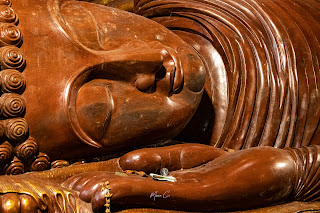
Nel complesso una immagine seriosa e solenne. Purtroppo non sono riuscita a trovare informazioni in merito all'autore o all'epoca. Di fronte vi è un edificio più piccolo, dove è collocata una statua del Buddha sdraiato, sempre in legno, di fattura sicuramente recente, il colore del legno è più chiaro rispetto all'altra statua. La parete alle spalle del Buddha sdraiato e la controfacciata sono interamente ricoperte da bassorilievi in legno che rappresentano uomini e animali che venerano Buddha. 


Da segnalare anche l'elegante scalinata che immette al prato dove sono collocati gli edifici. I due naga sono imponenti e molto eleganti, i lunghi corpi attraversano elementi ornamentali sempre di colore bianco. I gradoni di accesso di forma semicircolare ricordano anch'essi le squame della pelle dei draghi.


Non so dire quanto tempo abbiamo trascorso immerse in tanta bellezza, sicuramente il Wat Luang Khun Win ha il potere di farti sentire nostalgia ancora prima di ripartire. 

L'autista e Elide, compagna di avventura


[ENGLISH VERSION]


In the forest, on the mountain of mae win, there is a clearing where Buddha also stopped, probably enchanted by the beauty of the place. Here he met two lawa devotees, Khun Sap and Khun Srameng, who asked him to leave his footprint. The Buddha agreed, but the stone that should have received this footprint turned out to be too small, the heel and fingers did not remain impressed. At this point the Buddha was asked to leave some hair as a relic. Buddha then delivered five hairs into the hands of the two devotees. A chedi was built to preserve this important relic.


All this happened about 700 years ago. Since then the temple in the middle of the forest has had periods of prosperity and long years of neglect. Unfortunately, much of the historical documentation has also been lost. The temple has been enlarged and over the years has undergone several alterations. The last phase of restoration and revitalisation began in 1954 thanks to Baun Ruen Suphatto, a teacher at Wat Kuannimit in the San Pa Tong district. 

The extremely isolated location in the heart of the forest helps to maintain the temple's charm, understood in its literal meaning of attractiveness, also because of its magical atmosphere.  I became aware of the existence of Wat Luang Khun Win at least three years ago, looking at Google maps. I was struck by the fact that a temple with the name 'Luang', typical of temples with royal patronage, was in such a remote location and unknown to most people. Although my curiosity was piqued, I had to wait a long time, first because of the unfavourable season, then because of the closure due to the pandemic, and finally because of the accident that put me out of action for many months. In fact, I had made an attempt with other friends in July 2020, but tried to get through a route that was too difficult. You can find the story at this link

I finally got there via mae win, arriving by motorbike to the Karen Eco Lodge, then from here I had to give up and accept to continue by song teaw. The heavy rains and a physical shape far from that of the previous attempt convinced me that it was not the case to make attempts either by moped or on foot. On the advice of the owner of the resort we left in the morning at 08:00, to cover 10 kilometres the song teaw takes about an hour between ascents and descents on a road in many parts unpaved. When we arrived the gate was still closed and our driver went down to open it. 

When you yearn for so long to visit a place the risk of being disappointed is high, not because the place is actually less beautiful but because you have loaded it with too many expectations ... but in Thailand this does not happen. The emotion for such beauty in the middle of the forest was really great. After the abundant rain during the night, the sky remained cloudy and at times it cleared up, illuminating the lawn surrounding the temple buildings.


The recently restored chedi is white and stands out clearly against the green of the grass and trees and the brown wood of the buildings. The buildings are all modest in size, all made of teak wood, and in the highest one stands an extraordinary standing Buddha, at least six metres high, carved from a single teak trunk. The facial expression is unusual, not smiling, the feet are in front of each other and the back one is partially raised, but the hands are not in the classic walking Buddha position, but crossed below, one on top of the other. All in all a serious and solemn image.

Unfortunately I have not been able to find any information about the author or the time. Opposite there is a smaller building, where there is a statue of the reclining Buddha, also made of wood, certainly of recent manufacture, the colour of the wood is lighter than the other statue. The wall behind the reclining Buddha and the counter-façade are entirely covered with wooden bas-reliefs depicting men and animals worshipping Buddha. 

There is also an elegant staircase leading to the lawn where the buildings are located. The two nagas are imposing and very elegant, their long bodies crossing white ornamental elements. The semi-circular access steps are also reminiscent of the scales on a dragon's skin. 


I can not say how much time we spent immersed in such beauty, certainly Wat Luang Khun Win has the power to make you feel nostalgic even before leaving. 


mercoledì 20 ottobre 2021

WAT PHRAPHUTTHABAT SI ROI - IMPRONTE DEL BUDDHA NEL VERDE DELLA MONTAGNA WAT PHRAPHUTTHABAT SI ROI - FOOTPRINTS OF THE BUDDHA IN THE LUSH GREEN MOUNTAINS


[SCROLL DOWN FOR ENGLISH]

Nella prima giornata invernale del 2021 ho deciso di raggiungere uno di quei templi che da tempo desisderavo visitare ma, causa pandemia e incidente, avevo dovuto rinviare.


 Il  Wat Phraphutthabat Si Roi è più o meno a 1000 metri di altitudine e 50 chilometri di distanza da casa mia. Il tempio è di grande interesse ma la strada da percorrere per raggiungerlo merita quanto la meta. Il nome della mia regione di origine in Italia è indissolubilmente legato al colore verde, la "verde Umbria", il "cuore verde d'Italia"... Così penso che noi umbri abbiamo una particolare attitudine a riconoscere le diverse sfumature del colore verde. Ma solo vivendo in questa parte della Thailandia anche ad un umbra accade che l'occhio impari a selezionare e la vista a decifrare e riconoscere il verde lussureggiante.


In questo periodo dell'anno, alla fine della stagione delle piogge e all'inizio dell'inverno, percorrere le strade di montagna regala sensazioni uniche. I paesaggi e la luce cambiano come quinte di uno scenario, c'è silenzio e respirando a fondo si puo' sentire l'ossigeno entrare e rigenerarti. Una sensazione tra lo stupore e la meraviglia. 

Al termine del percorso ci trova di fronte all'imponente ingresso del Wat Phraphutthabat Si Roi, tempio molto popolare tra i thai in quanto qui sono conservate quattro impronte che la tradizione ritiene appartengano al Buddha


. Il fatto che le loro dimensioni siano assolutamente incompatibili con un piede umano nulla tolgono all'importanza e alla profonda devozione ad esse attribuite. Subito dopo lo straodinario portale di ingresso ci si trova di fronte ad un vasto piazzale, che in tempi pre-covid immagino ospitasse attività di vario tipo, ora appare abbastanza desolato.

Come sempre gli edifici che compongono l'insieme del Wat Phraphutthabat Si Roi sono molteplici e dislocati in un'area abbastanza vasta. Non ho visitato tutto perchè nel frattempo il cielo si era coperto ed ero abbastanza spaventata che arrivasse la pioggia a rovinare il viaggio di ritorno. Ho visitato il sito dell'impronta più grande. Nei solchi i thai lasciano soldi e foglie d'oro, sul bordo piccoli mazzi di fiori.


Da un lato c'erano alcune donne, vestite di bianco, sicuramente ospiti del centro Vipassana ospitato nel complesso del tempio, sedute in silenziosa meditazione. Non le ho fotografate per non essere invadente. Un altro edificio interessante è la sala delle ordinazioni, molto elegante e fittamente decorato. Sul posto ho visto diverse mae chi, e nessun monaco. Ho incrociato alcuni pellegrini, non più di tre auto. Immagino che in tempi normali l'afflusso sia maggiore, scoraggiato forse solo dalla posizione estremamente isolata. 

Ho cercato alcune informazioni in merito alle impronte del Buddha e sulle pratiche di devozione, vi riporto una citazione tradotta da Wikipedia:

"Come cetiya, l'impronta del Buddha era classificata in vari modi. Alcune erano uddesika, reliquie rappresentative, e altre erano paribhogika, reliquie d'uso o di contatto, e occasionalmente saririka, come se non fossero semplici impronte ma i veri piedi del Buddha. Alcune delle raffigurazioni delle impronte possono significare eventi nella vita del Buddha, ma altre possono essere state raffigurazioni di persone che veneravano nei santuari delle impronte: 86 .

Per chiarire: un'impronta del Buddha è un'immagine concava del suo piede (o dei suoi piedi), che si suppone sia stata lasciata da lui sulla terra per segnare intenzionalmente il suo passaggio su un punto particolare. Le immagini dei piedi del Buddha sono immagini convesse che rappresentano le vere e proprie piante dei suoi piedi, con tutte le loro caratteristiche. Seguendo la tradizionale triplice divisione dei cetiya, possiamo supporre che la prima forma dell'immagine dei piedi del Buddha - quella concava - sia una sorta di elemento pāribhogika, poiché è indissolubilmente legata al Tathāgata stesso. Il secondo può essere pensato come un elemento uddissaka, poiché è stato creato da un artista (o da artisti) devoto per commemorare il Buddha, prendendo come modello un'impronta autentica. Ma possiamo pensare anche questo secondo gruppo come un "pāribhogika per supposizione", come notato da Chutiwongs. Secondo lo studioso francese Paul Mus, le impronte erano il tipo di oggetti magici che "permettono di agire a distanza sulle persone ad esso legate."

Le reliquie assumono significato in base al potere che viene loro attribuito dal sentimeno dei fedeli. Non è necessario che siano "autentiche" perchè abbiano efficacia, dovremmo forse considerare meno miracolosa una guarigione solo perchè successivamente si scopre quella reliquia non appartenere al santo o guru di riferimeno? In questo senso non posso non pensare a quanto accaduto nei giorni scorsi a Fontaniva, in Italia, dove si è scoperto che le ossa attribuite al Beato Bertrando sono di epoca antecedente la sua morte e appartenenti a due corpi di sesso femminile.

Al ritorno il mio Google maps ha smesso di funzionare e tra memoria del percorso dell'andata e capacità di leggere i cartelli indicatori in thai, ho solo allungato di una decina di minuti...ma trascorsi sempre tra il verde lussureggiante, riuscendo anche ad evitare la pioggia.


[ENGLISH VERSION]

On the first winter's day of 2021 I decided to go to one of those temples that I had long wanted to visit but, due to pandemic and accident, had had to postpone. The Wat Phraphutthabat Si Roi is more or less at an altitude of 1000 metres and 50 kilometres away from my home. The temple is of great interest but the road to reach it is as worthwhile as the destination. The name of my home region in Italy is inextricably linked to the colour green, 'green Umbria', the 'green heart of Italy'... So I think we Umbrians have a particular aptitude for recognising the different shades of the colour green. But only by living in this part of Thailand does it happen to an Umbrian that the eye learns to select and the sight learns to decipher and recognise the lush green. At this time of year, at the end of the rainy season and the beginning of winter, driving along the mountain roads gives unique sensations. Landscapes and light change like backdrops, there is silence and breathing deeply you can feel the oxygen enter and regenerate you. A sensation between astonishment and wonder. 


At the end of the route we find ourselves in front of the imposing entrance to Wat Phraphutthabat Si Roi, a temple that is very popular with the Thai people because here are preserved four footprints that tradition believes belong to the Buddha. The fact that their size is absolutely incompatible with a human foot does not detract from the importance and deep devotion attributed to them. Immediately after the extraordinary entrance portal, one finds oneself in front of a vast square, which in pre-covid times I imagine housed activities of various kinds, but now appears quite desolate. As always, the buildings that make up the whole of Wat Phraphutthabat Si Roi are many and spread over a fairly large area. I didn't visit everything because in the meantime the sky had become overcast and I was quite scared that rain would come and ruin the trip back. I did visit the site of the largest footprint. In the grooves the Thais leave money and gold leaves, on the edge small bouquets of flowers. On one side there were some women, dressed in white, surely guests of the Vipassana centre housed in the temple complex, sitting in silent meditation. I have not photographed them so as not to be intrusive. Another interesting building is the ordering room, very elegant and densely decorated. On site I saw several mae chi, but no monks. I passed a few pilgrims, no more than three cars. I imagine that in normal times the influx is greater, perhaps discouraged only by the extremely isolated location. 


I looked for some information about the Buddha's footprints and devotional practices, here is a quote from Wikipedia:

"As cetiya, the Buddha's footprint was classified in a variety of ways. Some were uddesika, representational relics, and others were paribhogika, relics of use or of contact, and occasionally saririka, as though they were not just footprints but the Buddha's actual feet. Some of the depictions of the footprints may signify events in the life of the Buddha, but others may have been depictions of people worshipping at footprint shrines.

To clarify:[7] a footprint of the Buddha is a concave image of his foot (or feet), supposed to have been left by him on earth to purposefully mark his passage over a particular spot. The images of the Buddha’s feet are convex images which represent the actual soles of his feet, with all their characteristics. Following the traditional triple division of the cetiya, we can assume that the first form of the image of the Buddha’s feet – the concave one – is a sort of pāribhogika element, since it is indissolubly connected with the Tathāgata himself. The second one can be thought as an uddissaka element, since it was created by a devoted artist (or artists) to commemorate the Buddha, taking as its model a genuine footprint. But we can think of this second group, too, as a "pāribhogika by supposition", as noted by Chutiwongs. According to French scholar Paul Mus, the footprints were the type of magical objects which "enables one to act at a distance on people related to it"."

Relics take on significance according to the power attributed to them by the sentiment of the faithful. They do not need to be 'authentic' for them to be effective, should we perhaps consider a healing less miraculous just because it is later discovered that the relic does not belong to the saint or guru of reference? In this sense, I can't help but think of what has happened in recent days in Fontaniva, Italy, where it was discovered that the bones attributed to Blessed Bertrando date from before his death and belong to two female bodies.


On the way back my Google maps stopped working and between the memory of the outward route and the ability to read the signs in Thai, I only extended my journey by about ten minutes... but I always spent it among the lush greenery, managing to avoid the rain.

MONACHESIMO FEMMINILE: LA GOCCIA CHE SCAVA LA ROCCIA - FEMININE MONASTICISM: THE DROP THAT HOLDS THE ROCK

  [SCROLL FOR ENGLISH] In Thailandia le bikkhhuni esistono e stanno crescendo. Il turista medio occidentale quando immagina o ricorda un vi...