Visualizzazione post con etichetta Viaggi. Mostra tutti i post

mercoledì 4 maggio 2022

KOH LIPE PARADISO SOGNATO...QUASI PERDUTO - KOH LIPE PARADISE DREAMED OF...ALMOST LOST


[SCROLL DOWN FOR ENGLISH]

"Il mare è così bello che potrete provare solo nostalgia ancor prima di partire e riuscirete a sopportare la partenza solo perché consapevoli di poter tornare.."

Con questa frase concludevo il post dedicato alla vacanza a koh Lipe di novembre 2019, prima che succedesse tutto: pandemia, lockdown, incidente, Covid-19, problemi cardiaci, ecc... Mentre accadeva tutto questo avevo almeno un punto fermo: la prima vacanza possibile sarebbe stata a koh Lipe, per la grande nostalgia, per il bisogno di ritrovarmi in un ambiente bello e rilassante. Nell'arco di questi mesi per ben tre volte ho prenotato e per tre volte ho dovuto disdire...


Immaginate quindi il mio stato d'animo quando il 16 aprile sono arrivata in aeroporto qui a Chiang Mai, alle cinque e trenta del mattino, e la tipa della VietJet mi ha comunicato che il mio volo delle 06:45 era cancellato... Partenza rinviata alle 08:00. Tutto questo si è tradotto nel dover trascorrere una notte nel "Bara Resort" di Pak Bara dopo aver perso la barca per raggiungere l'isola. La sensazione di arrivare ogni volta più vicina all'obbiettivo e vederlo ogni volta spostato in avanti. Infine riesco ad arrivare a destinazione domenica 17 aprile, all'ora di pranzo. 


Per questa seconda vacanza a Lipe ho optato per alloggiare a Sunrise beach presso Castaway resort in un bel bungalow tutto in legno, con ampio patio.


Questo tipo di alloggio non ha aria condizionata ma solo un ventilatore, ma io non uso l'aria condizionata neanche a casa quindi mi sono trovata benissimo.

Quello che invece ho sofferto di più è la mancanza dello spruzzino vicino al water. Sono ormai talmente abituata che alla prima seduta ho trascorso alcuni secondi cercando con le mani di raggiungere il prezioso strumento e scoprendo così con angoscia la sua assenza. 

Sono stati giorni di assoluto relax e, dopo tutte le peripezie dei mesi passati, poter finalmente fare vita tra mare e bungalow è stato davvero rinvigorente.


Ho trovato una minuscola spiaggia, raggiungibile solo camminando nell'acqua e nuotando. Acqua limpida e pace assoluta. Ho recuperato un po' di tono muscolare e ogni giorno mi sono sentita meglio. 


Però per onestà devo, e ne sono molto dispiaciuta, raccontare anche alcuni aspetti meno piacevoli. Ho trovato l'isola molto sporca. Lungo le strade ci sono posizionati diversi cesti per la spazzatura ma forse c'è un problema poi nel servizio di svuotamento e raccolta e smaltimento. Purtroppo anche le spiagge presentano molti rifiuti e gli unici cestini li ho visti posizionati all'interno dei resort. Tornando spesso nelle stesse spiagge ho notato gli stessi rifiuti giacere per giorni e giorni. Ultima nota negativa è il gran numero di motorini e mezzi a motore, davvero centuplicato rispetto a due anni fa. Io sono consapevole che a volte questi mezzi sono indispensabili per lavorare, ecc... Ma temo che koh lipe entro qualche anno perda il suo primato di paradiso per appassionati di diving e natura.


[ENGLISH VERSION]

"The sea is so beautiful that you will only feel nostalgic even before you leave and you will only be able to bear the departure because you know you can come back.."


With this sentence I was concluding the post dedicated to my November 2019 holiday to koh Lipe, before everything happened: pandemic, lockdown, accident, Covid-19, heart problems, etc... While all this was happening I had at least one fixed point: the first possible holiday would be to koh Lipe, because of the great nostalgia, the need to find myself in a beautiful and relaxing environment. In the course of these months I booked three times and three times I had to cancel.... 


So imagine my mood when on 16 April I arrived at the airport here in Chiang Mai, at half past five in the morning, and the VietJet lady told me that my flight at 06:45 was cancelled... Departure postponed to 08:00. All this resulted in having to spend a night in the "Bara Resort" in Pak Bara after missing the boat to reach the island. The feeling of arriving closer to the goal each time and seeing it moved forward each time. Finally I manage to arrive at my destination on Sunday 17 April, at lunchtime. For this second holiday in Lipe I opted to stay at Sunrise beach at Castaway resort in a beautiful all-wood bungalow with a large patio. This type of lodging does not have air conditioning but only a fan, but I do not use the air conditioning even at home so I had a great time. What I suffered more is the lack of a sprayer near the toilet. I'm so used to it by now that at the first session I spent a few seconds trying to reach the precious instrument with my hands and was distressed to discover its absence. 

They were days of absolute relaxation and, after all the vicissitudes of the past months, finally being able to live life between the sea and the bungalow was really invigorating. I found a tiny beach, reachable only by walking in the water and swimming. Clear water and absolute peace. I regained some muscle tone and felt better every day. 


However, to be honest, I have to tell you about some of the less pleasant aspects. I found the island very dirty. Along the roads there are several rubbish bins, but perhaps there is a problem with the emptying, collection and disposal service. Unfortunately the beaches also have a lot of rubbish and the only bins I saw were placed inside the resorts. Returning often to the same beaches I noticed the same waste lying around for days on end. The last negative note is the large number of mopeds and motor vehicles, which has increased a hundredfold compared to two years ago. I am aware that sometimes these vehicles are indispensable for work, etc.... But I fear that within a few years Kohipe will lose its supremacy as a paradise for diving and nature lovers.


giovedì 4 novembre 2021

WAT LUANG KHUN WIN - IL TEMPIO NASCOSTO - THE HIDDEN TEMPLE


[ASCOLTA SU SPOTIFY]

[SCROLL DOWN FOR ENGLISH]

Nella foresta, sulla montagna di mae win, c'è una radura dove si è soffermato anche il Buddha, probabilmente anche lui incantato dalla bellezza del luogo. Qui ha incontrato due devoti lawa, Khun Sap e Khun Srameng che gli chiesero di lasciare la sua impronta. Il Buddha acconsentì, ma la pietra che avrebbe dovuto ricevere tale segno risultò essere troppo piccola, il tallone e le dita non rimasero impresse. A questo punto fu chiesto al Buddha di lasciare qualche capello come reliquia. Buddha consegnò allora nelle mani dei due devoti cinque capelli. Per conservare questa importante reliquia venne costruito un chedi. 


Tutto questo accadeva circa 700 anni fa. Da allora il tempio in mezzo alla foresta ha avuto periodi prosperità e lunghi anni di abbandono. Purtroppo si è persa anche gran parte della documentazione storica. Il tempio è stato ampliato e negli anni ha subito diversi rimaneggiamenti. L'ultima fase di restauro e di rivitalizzazione è iniziata nel 1954 grazie a Baun Ruen Suphatto, insegnante del Wat Kuannimit del distretto di San Pa Tong. 


La posizione estremamente isolata nel cuore della foresta contribuisce a mantenere intatto il fascino del tempio, inteso nel suo significato letterale di capacità di attrazione, anche per la sua atmosfera magica.  Sono venuta a conoscenza dell'esistenza del Wat Luang Khun Win almeno tre anni fa, osservando Google maps. Mi aveva colpito che un tempio caratterizzato dal denominativo "Luang", proprio dei templi con patrocinio reale, si trovasse in un luogo tanto sperduto e fosse sconosciuto ai più. Nonostante la curiosità fosse tanta, ho dovuto attendere a lungo prima a causa della stagione non propizia, poi per la chiusura a causa della pandemia e infine per l'incidente che mi ha messo fuori gioco per molti mesi. In realtà un tentativo lo avevo fatto insieme ad altri amici a luglio del 2020, cercando di passare però da un percorso troppo impervio. Potete trovare il racconto a questo link. 

Infine ci sono arrivata passando da mae win, arrivando in motorino fino al Karen Eco Lodge, poi da qui ho dovuto arrendermi e accettare di proseguire in song teaw. Le piogge abbondanti e una forma fisica ben lontana da quella del precedente tentativo mi hanno convinto che non fosse il caso di fare tentativi né in motorino né a piedi. Su consiglio della titolare del resort siamo partite la mattina alle 08:00, per percorrere 10 chilometri il song teaw impiega circa un'ora tra salite e discese su strada in molte parti sterrata. Quando siamo arrivate il cancello era ancora chiuso e il nostro autista è sceso ad aprire. 

Quando si agogna tanto tempo poter visitare un luogo il rischio di rimanerne delusi è alto, non perchè il posto sia effettivamente meno bello ma perché lo si è caricato di troppe aspettative...ma in Thailandia questo non accade. L'emozione per tanta bellezza in mezzo alla foresta è stata davvero tanta. Dopo la pioggia abbondante della notte, il cielo è rimasto nuvoloso e a tratti concede schiarite che illuminano il prato che circonda gli edifici del tempio.


Il chedi, recentemente restaurato appare di un bianco che stacca nettamente dal verde dell'erba e degli alberi, ma anche dal marrone del legno delle costruzioni. Gli edifici sono tutti di dimensioni modeste, tutti in legno di teak e in quello più in alto è collocato uno straordinario Buddha in piedi, alto almeno sei metri, ricavato da un unico tronco di teak.


L'espressione del volto è insolita, non sorridente, i piedi sono uno davanti all'altro e quello arretrato è parzialmente sollevato, ma le mani non sono nella classica posizione del Buddha che cammina, bensì incrociate in basso, una sull'altra.


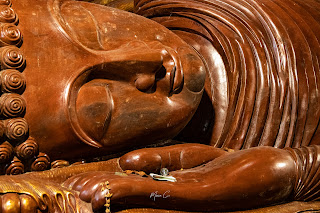
Nel complesso una immagine seriosa e solenne. Purtroppo non sono riuscita a trovare informazioni in merito all'autore o all'epoca. Di fronte vi è un edificio più piccolo, dove è collocata una statua del Buddha sdraiato, sempre in legno, di fattura sicuramente recente, il colore del legno è più chiaro rispetto all'altra statua. La parete alle spalle del Buddha sdraiato e la controfacciata sono interamente ricoperte da bassorilievi in legno che rappresentano uomini e animali che venerano Buddha. 


Da segnalare anche l'elegante scalinata che immette al prato dove sono collocati gli edifici. I due naga sono imponenti e molto eleganti, i lunghi corpi attraversano elementi ornamentali sempre di colore bianco. I gradoni di accesso di forma semicircolare ricordano anch'essi le squame della pelle dei draghi.


Non so dire quanto tempo abbiamo trascorso immerse in tanta bellezza, sicuramente il Wat Luang Khun Win ha il potere di farti sentire nostalgia ancora prima di ripartire. 

L'autista e Elide, compagna di avventura


[ENGLISH VERSION]


In the forest, on the mountain of mae win, there is a clearing where Buddha also stopped, probably enchanted by the beauty of the place. Here he met two lawa devotees, Khun Sap and Khun Srameng, who asked him to leave his footprint. The Buddha agreed, but the stone that should have received this footprint turned out to be too small, the heel and fingers did not remain impressed. At this point the Buddha was asked to leave some hair as a relic. Buddha then delivered five hairs into the hands of the two devotees. A chedi was built to preserve this important relic.


All this happened about 700 years ago. Since then the temple in the middle of the forest has had periods of prosperity and long years of neglect. Unfortunately, much of the historical documentation has also been lost. The temple has been enlarged and over the years has undergone several alterations. The last phase of restoration and revitalisation began in 1954 thanks to Baun Ruen Suphatto, a teacher at Wat Kuannimit in the San Pa Tong district. 

The extremely isolated location in the heart of the forest helps to maintain the temple's charm, understood in its literal meaning of attractiveness, also because of its magical atmosphere.  I became aware of the existence of Wat Luang Khun Win at least three years ago, looking at Google maps. I was struck by the fact that a temple with the name 'Luang', typical of temples with royal patronage, was in such a remote location and unknown to most people. Although my curiosity was piqued, I had to wait a long time, first because of the unfavourable season, then because of the closure due to the pandemic, and finally because of the accident that put me out of action for many months. In fact, I had made an attempt with other friends in July 2020, but tried to get through a route that was too difficult. You can find the story at this link. 

I finally got there via mae win, arriving by motorbike to the Karen Eco Lodge, then from here I had to give up and accept to continue by song teaw. The heavy rains and a physical shape far from that of the previous attempt convinced me that it was not the case to make attempts either by moped or on foot. On the advice of the owner of the resort we left in the morning at 08:00, to cover 10 kilometres the song teaw takes about an hour between ascents and descents on a road in many parts unpaved. When we arrived the gate was still closed and our driver went down to open it. 

When you yearn for so long to visit a place the risk of being disappointed is high, not because the place is actually less beautiful but because you have loaded it with too many expectations ... but in Thailand this does not happen. The emotion for such beauty in the middle of the forest was really great. After the abundant rain during the night, the sky remained cloudy and at times it cleared up, illuminating the lawn surrounding the temple buildings.


The recently restored chedi is white and stands out clearly against the green of the grass and trees and the brown wood of the buildings. The buildings are all modest in size, all made of teak wood, and in the highest one stands an extraordinary standing Buddha, at least six metres high, carved from a single teak trunk. The facial expression is unusual, not smiling, the feet are in front of each other and the back one is partially raised, but the hands are not in the classic walking Buddha position, but crossed below, one on top of the other. All in all a serious and solemn image.

Unfortunately I have not been able to find any information about the author or the time. Opposite there is a smaller building, where there is a statue of the reclining Buddha, also made of wood, certainly of recent manufacture, the colour of the wood is lighter than the other statue. The wall behind the reclining Buddha and the counter-façade are entirely covered with wooden bas-reliefs depicting men and animals worshipping Buddha. 


There is also an elegant staircase leading to the lawn where the buildings are located. The two nagas are imposing and very elegant, their long bodies crossing white ornamental elements. The semi-circular access steps are also reminiscent of the scales on a dragon's skin. 


I can not say how much time we spent immersed in such beauty, certainly Wat Luang Khun Win has the power to make you feel nostalgic even before leaving. 


lunedì 6 gennaio 2020

ITINERARI INSOLITI - PARTE PRIMA: SAK YANT E WAT PHU TOK / UNUSUAL ITINERARIES - PART ONE: SAK YANT AND WAT PHU TOK

(SCROLL DOWN FOR ENGLISH)

Dopo una elaborata programmazione abbiamo creato un percorso di viaggio adatto a chi già conosce i siti turistici più noti della Thailandia e vuole dedicarsi a conoscere nuovi posti, a volte quasi del tutto ignorati dal turismo di massa. Quindi in questo post non troverete spiagge o isole, palazzi reali o puttan tour....  

La prima tappa del viaggio è Chiang Mai, la mia compagna di viaggio, Mariangela, è arrivata dall'Italia alle sei del mattino del 27 dicembre. Dopo una breve sosta a casa mia per una doccia e un caffè si parte in motorino in direzione Doi Saket. Circa quaranta chilometri per raggiungere Arjarn Nit con cui abbiamo appuntamento. Entrambe abbiamo il desiderio di un terzo sak-yant e casualmente abbiamo anche già deciso lo stesso soggetto: haa teaw, le cinque righe di benedizioni.
Causa i lavori in corso la strada ci regala qualche brivido ma, sempre sia lodato Google Maps, riusciamo ad arrivare a destinazione in orario. Il posto è molto semplice e ancora in costruzione. Mentre parcheggiamo Arjarn Nit richiama la nostra attenzione, invitandoci a raggiungerlo nel terrazzino dove sta facendo colazione. Il maestro insiste più volte finchè accettiamo del caffè e del tè, tramite la sua assistente si scusa molto per non aver potuto venire a prenderci, spiega che il giorno dopo ci sarà una cerimonia importante e sono impegnati nei preparativi. Arjarn Nit ha un aspetto molto curato e rassicurante, modalità da basso profilo di chi è davvero consapevole del proprio valore e non sente la necessità di vantarsene o di esibire  i propri successi. Una di quelle persone che vorresti avere come zio o comunque parente, in modo di avere assicurate occasioni di incontrarlo abitualmente. Dopo la colazione l'arjarn è andato a prepararsi e poi ci ha invitato a raggiungerlo nella grande sala dove pratica in mezzo a statue del buddha e altre figure. Anche se avevamo già espresso la nostra scelta l'assistente ci ha dato da consultare una sorta di catalogo con i diversi disegni, non c'è nessuna indicazione di prezzo. Rimaniamo ferme nella nostra scelta e la prima a ricevere il sak-yant è Mariangela.

Una volta terminato il tatuaggio segue il rito dell'attivazione che gli dà vita e l'energia necessaria a svolgere la loro funzione di protezione o altre a cui sono preposti.

Solo al termine l'assistente ci consegnerà due buste rosse invitandoci ad utilizzarle per una libera offerta, senza indicare alcuna cifra e ripetendo che eravamo libere di decidere se e quanto lasciare. Dopo averle consegnate abbiamo ripreso la nostra strada verso Chiang Mai con la consapevolezza di aver avuto un incontro con una persona eccezionale e già con il desiderio di tornare. 

Nel pomeriggio ci concediamo un massaggio ai piedi presso uno dei centri Lila e poi breve passeggiata in centro e infine cena in zona Nimmahim.

Il secondo giorno la sveglia suona molto presto, dobbiamo partire con il volo delle 06:10 per Udonthani. Alle cinque del mattino per fortuna non c'è molto traffico perchè andare in due in motorino con uno zaino da nove chili e un trolley di pari peso, più lo zainetto con l'attrezzatura fotografica rende la guida non troppo agevole. Udon è in realtà solo una sosta tecnica, arriviamo presto perchè non c'erano altri voli disponibili e ne approfittiamo per un giro nei dintorni presso un tempio ancora in costruzione dove è stato collocato un gigantesco buddha bianco, secondo una modalità devozionale che si sta diffondendo in questi ultimi tempi. 


Per la gioia di Mariangela il nostro albergo, Prajaktra Design Hotel, è attaccato al parco con il laghetto dove staziona l'enorme papera gonfiabile divenuta simbolo della città e per l'occasione addobbata per il Capodanno. 

Il terzo giorno di viaggio inizia ancora all'alba, l'appuntamento con l'autista è alle sei e la nostra destinazione è nella provincia di  Bueng Kan a quasi 300 chilometri di distanza: wat phu tok, letteralmente il tempio del monte solitario in dialetto locale. 

Il van è solo per noi due e in un secondo sdraiamo i sedili e recuperiamo un po' di sonno. Quando siamo vicine alla meta cominciamo ad intravedere da lontano Phu Thok, un emblematico affioramento di arenaria che è allo stesso tempo un punto di riferimento locale e il simbolo della provincia di Bueng Kan. Si tratta di due picchi, quello più basso, circa 350 metri, è trasformato in luogo di pellegrinaggio in quanto vi è collocato un tempio le cui diverse parti sono collocate lungo il percorso verso la vetta. Per salire il percorso è stato dotato di una serie di scale di legno, alcune molto ripide. 


I livelli più alti presentano poi delle strette passerelle che permettono di fare il giro completo affacciati a 300 metri di altezza, camminando su delle tavole non troppo rassicuranti. 


Pero' il senso di soddisfazione e l'entusiasmo per la bellezza della vista che si apre davanti agli occhi permetteranno di superare ogni timore. Durante tutta la visita abbiamo incrociato solo un altro turista occidentale e spesso nell'avvicinarci a gruppi di turisti locali li sentivamo esclamare con sorpresa: "farang/straniere"! Un piacevolissimo ricordo ce lo ha regalato una giovane mamma che, incontrandoci, senza dire una parola e con un sorriso ci ha regalato due mandarini a testa...le siamo grate perchè da incoscienti avevamo dimenticato di portare con noi acqua da bere e qualsiasi genere di conforto. 

(ENGLISH VERSION)
After an elaborate planning we have created a travel route suitable for those who already know the most famous tourist sites in Thailand and want to dedicate themselves to getting to know new places, sometimes almost completely ignored by mass tourism. So in this post you won't find beaches or islands, royal palaces or puttan tours.....  
The first stop of the trip is Chiang Mai, my travel companion, Mariangela, arrived from Italy at six in the morning on December 27th. After a short stop at my house for a shower and a coffee we set off on our motorbike towards Doi Saket. About forty kilometers to reach Arjarn Nit with whom we have an appointment. Both of us have the desire for a third sak-yant and casually we have also already decided the same subject: haa teaw, the five lines of blessings.

Because of the work in progress the road gives us a few thrills but, praise be to Google Maps, we manage to get there on time. The place is very simple and still under construction. While we park Arjarn Nit draws our attention, inviting us to join him in the terrace where he is having breakfast. The Maestro insists several times until we accept some coffee and tea, through his assistant he apologises a lot for not being able to pick us up, explains that the next day there will be an important ceremony and they are busy with preparations. Arjarn Nit has a very nice and reassuring look, a low-profile manner of someone who is really aware of his own value and doesn't feel the need to brag about it or show off his achievements. One of those people that you would like to have as an uncle or otherwise a relative, so that you have assured opportunities to meet him regularly. After breakfast the arjarn went to get ready and then invited us to join him in the great hall where he practices among Buddha statues and other figures. Although we had already expressed our choice the assistant gave us to consult a sort of catalogue with the different drawings, there is no indication of price. We remain firm in our choice and the first to receive the sak-yant is Mariangela.

Once the tattoo is finished, it follows the ritual of activation that gives it life and the energy necessary to carry out their protective function or others they are in charge of. 

Only at the end the assistant will give us two red envelopes inviting us to use them for a free offer, without indicating any amount and repeating that we were free to decide if and how much to leave. After handing them over we went back on our way to Chiang Mai with the awareness of having had a meeting with an exceptional person and already with the desire to return. 
In the afternoon we enjoyed a foot massage at one of the Lila centers and then a short walk in the downtown area and finally dinner in the Nimmahim area.

On the second day the alarm clock sounds very early, we have to leave with the 06:10 flight to Udonthani. At five o'clock in the morning luckily there isn't a lot of traffic because the two of us have to go by moped with a nine kilos backpack and a trolley of the same weight, plus the backpack with the photographic equipment makes driving not too easy. Udon is actually just a technical stop, we arrive early because there were no other flights available and we take advantage of it for a tour around a temple still under construction where a giant white Buddha has been placed, according to a devotional mode that is spreading in recent times. 

To Mariangela's delight, our hotel, Prajaktra Design Hotel, is attached to the park with the pond where the huge inflatable duck, which has become the symbol of the city and for the occasion decorated for New Year's Eve.

The third day of travel starts at dawn, the appointment with the driver is at six and our destination is in the province of Bueng Kan almost 300 kilometers away: wat phu tok, literally the temple of the lonely mountain in local dialect. 

The van is just for the two of us and in a second we lay down the seats and get some sleep. When we are close to the destination we begin to catch a glimpse of Phu Thok, an emblematic sandstone outcrop that is both a local landmark and the symbol of the province of Bueng Kan. It is two peaks, the lowest one, about 350 meters, is transformed into a place of pilgrimage as there is a temple whose different parts are located along the path to the summit. To climb the path has been equipped with a series of wooden stairs, some very steep. 

The higher levels then have narrow walkways that allow you to make the complete tour facing 300 meters high, walking on boards that are not too reassuring. 


But the sense of satisfaction and enthusiasm for the beauty of the sight that opens before your eyes will allow you to overcome any fear. During the whole visit we met only one other western tourist and often when approaching groups of local tourists we heard them exclaim with surprise: "farang/ foreigners"! A very pleasant memory was given us by a young mother who, meeting us, without saying a word and with a smile gave us two tangerines each ... we are grateful to her because recklessly we had forgotten to bring with us water to drink and any kind of comfort. 


mercoledì 19 giugno 2019

MAE HONG SON - MONTAGNE E BUON CIBO - MOUNTAINS AND GOOD FOOD


[SCROLL DOWN FOR ENGLISH]

Può sembrare strano decidere di andare in vacanza in mezzo alle montagne mentre si è ai tropici. Ma può accadere quando il mare è abbastanza lontano e il tempo a disposizione non è molto. Soprattutto poi nel caso si stia cercando una vacanza rilassante. 

L'anno scorso a Ferragosto sono stata in questo piccolo paese che si chiama Mae Hong Son, davvero annidato in mezzo alle montagne in una stretta vallata, vicinissima al confine con il Myanmar. La cittadina è deliziosa, molto piccola e ordinata. E' un punto di partenza per attività di trekking lungo sentieri all'interno del parco nazionale. Per un discorso di pigrizia, per evitare di fare in pullman le oltre sei ore di viaggio lungo i tortuosi 300 km di strada, ho deciso di andare in aereo da Chiang Mai.

Volo brevissimo, ma vale il viaggio rendersi poi conto di dove  riesca ad atterrare il vostro aereo ad elica con non più di 25 persone a bordo.

Per il resto vi ritroverete in un paesaggio incantato, con i ritmi lenti della gente di montagna che ha però un grande senso dell'ospitalità. Nel breve soggiorno ho fatto delle belle passeggiate e visitato i templi della città, nuotato nella piscina del resort e scoperto un'autentica delizia culinaria il pollo arrostito in foglie di pandano che è diventato il principale nutrimento di quella breve vacanza.


Ho alloggiato al Fern Resort che rimane a qualche chilometro dal centro del paese ma ha il vantaggio di essere il punto di partenza per escursioni di trekking.
Una passeggiata molto interessante è alle cascate di Mae Surin, io mi sono fermata poco prima prima perchè l'ultimo tratto di sentiero mi è sembrato troppo scivoloso, ad agosto siamo nella stagione piovosa, ed essendo sola non me la sono sentita di rischiare, anche se il guardiaparco all'ingresso vi scatta la foto prima di farvi entrare per sapere eventualmente chi manchi. Ma il paesaggio e il verde intorno aiutano davvero a rigenerarsi.


Mi sono anche dedicata a visitare il centro urbano con i suoi templi salendo a piedi fino al Wat Phrathat Doi Kongmu in cima ad una piccola collina nel centro della città. Da qui si ha una splendida vista panoramica e si ha anche modo di vedere quanto la pista dell'aeroporto sia incastrata tra i monti.

Mi riprometto di tornare ancora a Mae Hong Son per altre passeggiate e per il fascino del suo silenzio...


[ENGLISH VERSION]

It may seem strange to decide to go on holiday in the middle of the mountains while you are in the tropics. But it can happen when the sea is far enough away and the time available is not much. Especially if you are looking for a relaxing holiday. 
Last year in August I was in this small town called Mae Hong Son, really nestled in the mountains in a narrow valley, very close to the border with Myanmar. The town is delightful, very small and tidy. It is a starting point for trekking activities along paths inside the national park. For a speech of laziness, to avoid making by bus the more than six hours of travel along the winding 300 km of road, I decided to go by plane from Chiang Mai.
It's a very short flight, but it's worth the trip to realize where your propeller plane can land with no more than 25 people on board. 

For the rest you will find yourself in an enchanted landscape, with the slow rhythms of the mountain people who have a great sense of hospitality. In the short stay I took some nice walks and visited the temples of the city, swam in the pool of the resort and discovered an authentic culinary delight the chicken roasted in pandan leaves that has become the main food of that short holiday.
I stayed at the Fern Resort which is located just a few kilometers from the centre of the village but has the advantage of being the starting point for trekking excursions.
A very interesting walk is to the waterfalls of Mae Surin, I stopped just before because the last stretch of the path seemed too slippery to me, in August we are in the rainy season, and being alone I did not feel like taking risks, even if the park ranger at the entrance takes the picture before letting you in to find out who is missing. But the landscape and the green around really help to regenerate.
I have also dedicated myself to visit the urban center with its temples climbing on foot up to Wat Phrathat Doi Kongmu on top of a small hill in the center of the city. From here you have a beautiful panoramic view and you also have the opportunity to see how much the airport runway is wedged between the mountains.
I promise to return again to Mae Hong Son for other walks and for the charm of its silence...

MONACHESIMO FEMMINILE: LA GOCCIA CHE SCAVA LA ROCCIA - FEMININE MONASTICISM: THE DROP THAT HOLDS THE ROCK

  [SCROLL FOR ENGLISH] In Thailandia le bikkhhuni esistono e stanno crescendo. Il turista medio occidentale quando immagina o ricorda un vi...