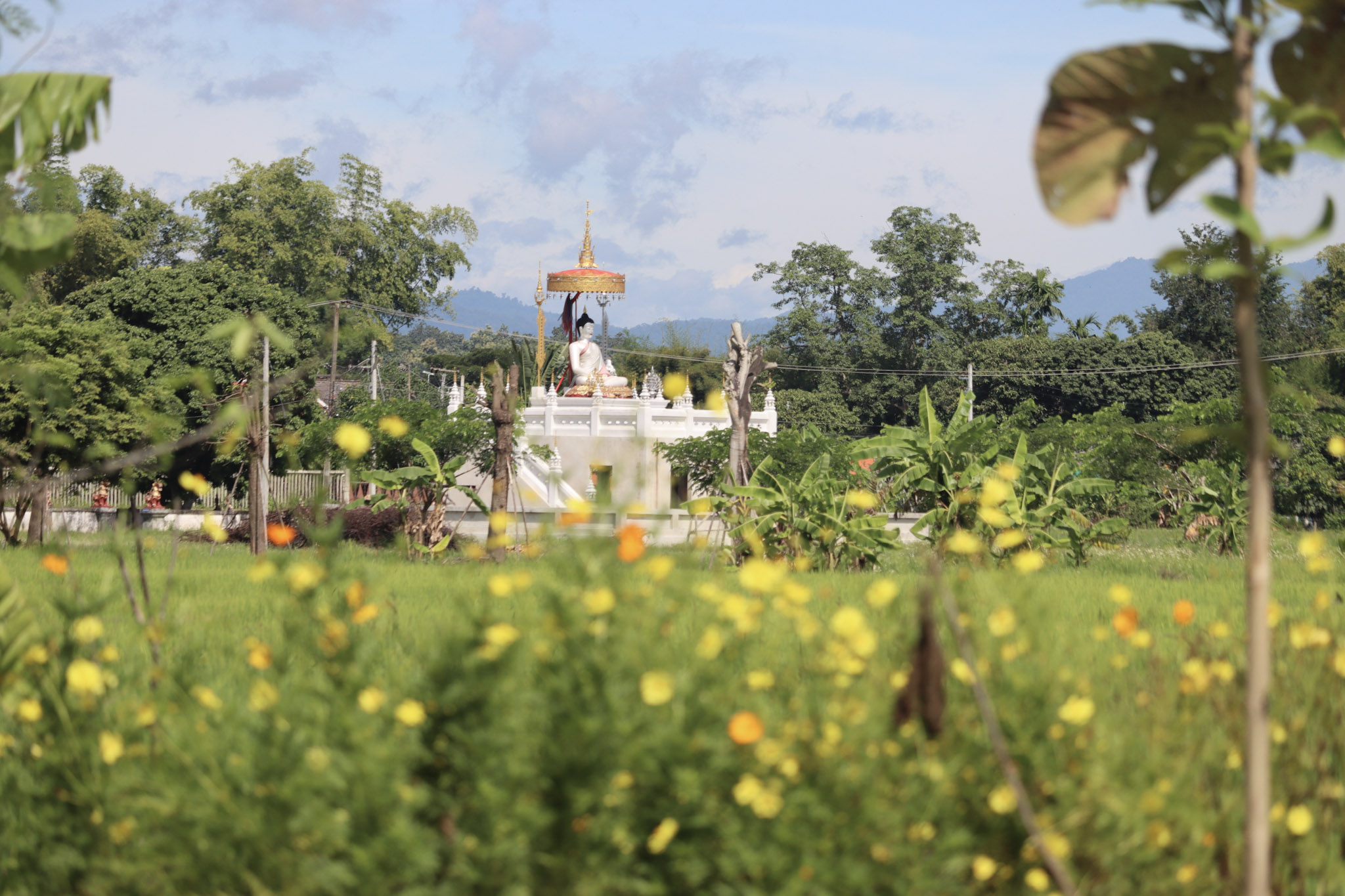
Nella prima giornata invernale del 2021 ho deciso di raggiungere uno di quei templi che da tempo desisderavo visitare ma, causa pandemia e incidente, avevo dovuto rinviare.

Il Wat Phraphutthabat Si Roi è più o meno a 1000 metri di altitudine e 50 chilometri di distanza da casa mia. Il tempio è di grande interesse ma la strada da percorrere per raggiungerlo merita quanto la meta. Il nome della mia regione di origine in Italia è indissolubilmente legato al colore verde, la "verde Umbria", il "cuore verde d'Italia"... Così penso che noi umbri abbiamo una particolare attitudine a riconoscere le diverse sfumature del colore verde. Ma solo vivendo in questa parte della Thailandia anche ad un umbra accade che l'occhio impari a selezionare e la vista a decifrare e riconoscere il verde lussureggiante.

In questo periodo dell'anno, alla fine della stagione delle piogge e all'inizio dell'inverno, percorrere le strade di montagna regala sensazioni uniche. I paesaggi e la luce cambiano come quinte di uno scenario, c'è silenzio e respirando a fondo si puo' sentire l'ossigeno entrare e rigenerarti. Una sensazione tra lo stupore e la meraviglia.

Al termine del percorso ci trova di fronte all'imponente ingresso del Wat Phraphutthabat Si Roi, tempio molto popolare tra i thai in quanto qui sono conservate quattro impronte che la tradizione ritiene appartengano al Buddha

. Il fatto che le loro dimensioni siano assolutamente incompatibili con un piede umano nulla tolgono all'importanza e alla profonda devozione ad esse attribuite. Subito dopo lo straodinario portale di ingresso ci si trova di fronte ad un vasto piazzale, che in tempi pre-covid immagino ospitasse attività di vario tipo, ora appare abbastanza desolato.

Come sempre gli edifici che compongono l'insieme del Wat Phraphutthabat Si Roi sono molteplici e dislocati in un'area abbastanza vasta. Non ho visitato tutto perchè nel frattempo il cielo si era coperto ed ero abbastanza spaventata che arrivasse la pioggia a rovinare il viaggio di ritorno. Ho visitato il sito dell'impronta più grande. Nei solchi i thai lasciano soldi e foglie d'oro, sul bordo piccoli mazzi di fiori.


Da un lato c'erano alcune donne, vestite di bianco, sicuramente ospiti del centro Vipassana ospitato nel complesso del tempio, sedute in silenziosa meditazione. Non le ho fotografate per non essere invadente. Un altro edificio interessante è la sala delle ordinazioni, molto elegante e fittamente decorato. Sul posto ho visto diverse mae chi, e nessun monaco. Ho incrociato alcuni pellegrini, non più di tre auto. Immagino che in tempi normali l'afflusso sia maggiore, scoraggiato forse solo dalla posizione estremamente isolata.
Ho cercato alcune informazioni in merito alle impronte del Buddha e sulle pratiche di devozione, vi riporto una citazione tradotta da Wikipedia:
"Come cetiya, l'impronta del Buddha era classificata in vari modi. Alcune erano uddesika, reliquie rappresentative, e altre erano paribhogika, reliquie d'uso o di contatto, e occasionalmente saririka, come se non fossero semplici impronte ma i veri piedi del Buddha. Alcune delle raffigurazioni delle impronte possono significare eventi nella vita del Buddha, ma altre possono essere state raffigurazioni di persone che veneravano nei santuari delle impronte: 86 .
Per chiarire: un'impronta del Buddha è un'immagine concava del suo piede (o dei suoi piedi), che si suppone sia stata lasciata da lui sulla terra per segnare intenzionalmente il suo passaggio su un punto particolare. Le immagini dei piedi del Buddha sono immagini convesse che rappresentano le vere e proprie piante dei suoi piedi, con tutte le loro caratteristiche. Seguendo la tradizionale triplice divisione dei cetiya, possiamo supporre che la prima forma dell'immagine dei piedi del Buddha - quella concava - sia una sorta di elemento pāribhogika, poiché è indissolubilmente legata al Tathāgata stesso. Il secondo può essere pensato come un elemento uddissaka, poiché è stato creato da un artista (o da artisti) devoto per commemorare il Buddha, prendendo come modello un'impronta autentica. Ma possiamo pensare anche questo secondo gruppo come un "pāribhogika per supposizione", come notato da Chutiwongs. Secondo lo studioso francese Paul Mus, le impronte erano il tipo di oggetti magici che "permettono di agire a distanza sulle persone ad esso legate."
Le reliquie assumono significato in base al potere che viene loro attribuito dal sentimeno dei fedeli. Non è necessario che siano "autentiche" perchè abbiano efficacia, dovremmo forse considerare meno miracolosa una guarigione solo perchè successivamente si scopre quella reliquia non appartenere al santo o guru di riferimeno? In questo senso non posso non pensare a quanto accaduto nei giorni scorsi a Fontaniva, in Italia, dove si è scoperto che le ossa attribuite al Beato Bertrando sono di epoca antecedente la sua morte e appartenenti a due corpi di sesso femminile.

Al ritorno il mio Google maps ha smesso di funzionare e tra memoria del percorso dell'andata e capacità di leggere i cartelli indicatori in thai, ho solo allungato di una decina di minuti...ma trascorsi sempre tra il verde lussureggiante, riuscendo anche ad evitare la pioggia.

[ENGLISH VERSION]
On the first winter's day of 2021 I decided to go to one of those temples that I had long wanted to visit but, due to pandemic and accident, had had to postpone. The Wat Phraphutthabat Si Roi is more or less at an altitude of 1000 metres and 50 kilometres away from my home. The temple is of great interest but the road to reach it is as worthwhile as the destination. The name of my home region in Italy is inextricably linked to the colour green, 'green Umbria', the 'green heart of Italy'... So I think we Umbrians have a particular aptitude for recognising the different shades of the colour green. But only by living in this part of Thailand does it happen to an Umbrian that the eye learns to select and the sight learns to decipher and recognise the lush green. At this time of year, at the end of the rainy season and the beginning of winter, driving along the mountain roads gives unique sensations. Landscapes and light change like backdrops, there is silence and breathing deeply you can feel the oxygen enter and regenerate you. A sensation between astonishment and wonder.
At the end of the route we find ourselves in front of the imposing entrance to Wat Phraphutthabat Si Roi, a temple that is very popular with the Thai people because here are preserved four footprints that tradition believes belong to the Buddha. The fact that their size is absolutely incompatible with a human foot does not detract from the importance and deep devotion attributed to them. Immediately after the extraordinary entrance portal, one finds oneself in front of a vast square, which in pre-covid times I imagine housed activities of various kinds, but now appears quite desolate. As always, the buildings that make up the whole of Wat Phraphutthabat Si Roi are many and spread over a fairly large area. I didn't visit everything because in the meantime the sky had become overcast and I was quite scared that rain would come and ruin the trip back. I did visit the site of the largest footprint. In the grooves the Thais leave money and gold leaves, on the edge small bouquets of flowers. On one side there were some women, dressed in white, surely guests of the Vipassana centre housed in the temple complex, sitting in silent meditation. I have not photographed them so as not to be intrusive. Another interesting building is the ordering room, very elegant and densely decorated. On site I saw several mae chi, but no monks. I passed a few pilgrims, no more than three cars. I imagine that in normal times the influx is greater, perhaps discouraged only by the extremely isolated location.
I looked for some information about the Buddha's footprints and devotional practices, here is a quote from Wikipedia:
"As cetiya, the Buddha's footprint was classified in a variety of ways. Some were uddesika, representational relics, and others were paribhogika, relics of use or of contact, and occasionally saririka, as though they were not just footprints but the Buddha's actual feet. Some of the depictions of the footprints may signify events in the life of the Buddha, but others may have been depictions of people worshipping at footprint shrines.
To clarify:[7] a footprint of the Buddha is a concave image of his foot (or feet), supposed to have been left by him on earth to purposefully mark his passage over a particular spot. The images of the Buddha’s feet are convex images which represent the actual soles of his feet, with all their characteristics. Following the traditional triple division of the cetiya, we can assume that the first form of the image of the Buddha’s feet – the concave one – is a sort of pāribhogika element, since it is indissolubly connected with the Tathāgata himself. The second one can be thought as an uddissaka element, since it was created by a devoted artist (or artists) to commemorate the Buddha, taking as its model a genuine footprint. But we can think of this second group, too, as a "pāribhogika by supposition", as noted by Chutiwongs. According to French scholar Paul Mus, the footprints were the type of magical objects which "enables one to act at a distance on people related to it"."
Relics take on significance according to the power attributed to them by the sentiment of the faithful. They do not need to be 'authentic' for them to be effective, should we perhaps consider a healing less miraculous just because it is later discovered that the relic does not belong to the saint or guru of reference? In this sense, I can't help but think of what has happened in recent days in Fontaniva, Italy, where it was discovered that the bones attributed to Blessed Bertrando date from before his death and belong to two female bodies.
On the way back my Google maps stopped working and between the memory of the outward route and the ability to read the signs in Thai, I only extended my journey by about ten minutes... but I always spent it among the lush greenery, managing to avoid the rain.