venerdì 28 maggio 2021

LA DIGA DI MAE KUANG E IL PONTE SOSPESO (E I LUCCHETTI DI MOCCIA) - THE MAE KUANG DAM AND THE SUSPENSION BRIDGE (AND MOCCIA'S PADLOCKS) -

[SCROLL DOWN FOR ENGLISH]

La prima volta che ho notato questa località è stato durante la visita al wat phrabat tin nok

Il wat phrabat tin nok visto dalla diga

da una delle sue terrazze avevo visto in lontananza questa piccola diga imersa nel verde e intravisto il suo caratteristico ponte sospeso. Era il settembre del 2019, nel frattempo ci sono state altre attrazioni, lockdown, accidenti vari, e alla fine dopo quasi due anni si è riaffacciato il ricordo e ho deciso di andare a vedere finalmente la diga di Mae Kuang, che si trova a nord est di Chiang Mai, trenta chilometri da casa mia. Il luogo è molto bello, immerso tra le montagne, da qui partono diversi sentieri, uno dei percorsi più interessanti credo sia quello che arriva fino alle cascate di Bua Tong, note come sticky waterfalls.


Da quel che ho visto in tempi normali funziona anche un servizio di barche, probabilmente per raggiungere rapidamente le sponde opposte. Altrimenti si puo' utilizzare un ponte sospeso molto scenografico,


E qui ho trovato, quello che avevo visto in qualche foto ma che non sapevo dove collocare, una lunga serie di lucchetti appesi, le cui chiavi probabilmente giacciono sul fondo dello specchio d'acqua sottostante...insomma avete capito bene, la moda nata in Italia, a seguito del libro di Federico Moccia, è arrivata fino a Chiang Mai.

 Il posto è molto frequentato sia da chi si dedica ad escursioni, sia per pic-nic a base di barbecue e alcool come da usanza locale.

Ci sono anche alcuni ristoranti, ma sembrano ormai chiusi da tempo, probabilmente a causa delle restrizioni per il Covid-19. Il luogo ha quindi diversi motivi di attrazione escursionismo, pesca o semplicemente rilassarsi mentre si guarda il verde delle foreste tutto intorno. Un luogo dove tornero' sicuramente, perchè in realtà ho visto solo una minima parte. 

[ENGLISH VERSION]

The first time I noticed this location was while visiting wat phrabat tin nok, from one of its terraces I had seen in the distance this small dam surrounded by greenery and glimpsed its characteristic suspension bridge. It was September 2019, in the meantime there had been other attractions, lockdowns, various accidents, and finally after almost two years the memory came back and I decided to finally go and see the Mae Kuang dam, which is located northeast of Chiang Mai, thirty kilometres from my home. The place is very beautiful, nestled in the mountains, from here start several paths, one of the most interesting is the one that goes up to the Bua Tong waterfalls, known as sticky waterfalls. From what I have seen in normal times there is also a boat service, probably to reach quickly the opposite banks. Otherwise you can use a very scenic suspension bridge. And here I found what I had seen in a few photos but didn't know where to put it, a long series of hanging padlocks, the keys to which probably lie on the bottom of the water below...so you got it right,the fashion born in Italy, following Federico Moccia's book, has arrived in Chiang Mai. The place is very popular both with those who go on excursions and for picnics based on barbecue and alchol, as is the local custom. There are also a few restaurants, but they seem to have been closed for some time now, probably due to the Covid-19 restrictions. So the place has several attractions hiking, fishing or just relaxing while looking at the forests all around. A place I will definitely come back to, because I have actually only seen a small part of it.


lunedì 12 aprile 2021

HORROR VACUI DELLA VERITÀ - TRUTH'S HORROR VACUI


[SCROLL FOR ENGLISH]

 ...ci sono luoghi, anche qui in Thailandia, in cui non vorrei mai andare per svariati motivi, uno di questi è Pattaya, la cui storia moderna è strettamente connessa allo sviluppo della prostituzione di questo paese. Un posto di mare dove l'ultimo motivo di attrazione è il mare, personalmente non è il posto dove vorrei andare in vacanza. 

Però succede che da qualche anno a Pattaya è visitabile una straordinaria installazione di arte contemporanea, la cui costruzione è iniziata nel 1981 ma non è ancora conclusa e forse non lo sarà mai. 

Il titolo dell'opera è Sanctuary of truth, ปราสาทสัจธรรม (Prasat Satchatham) realizzato da una idea di Lek Viriyaphan, un ricco uomo di affari, già promotore di progetti visionari come Muang Boran e Erawan Museum a Bangkok.

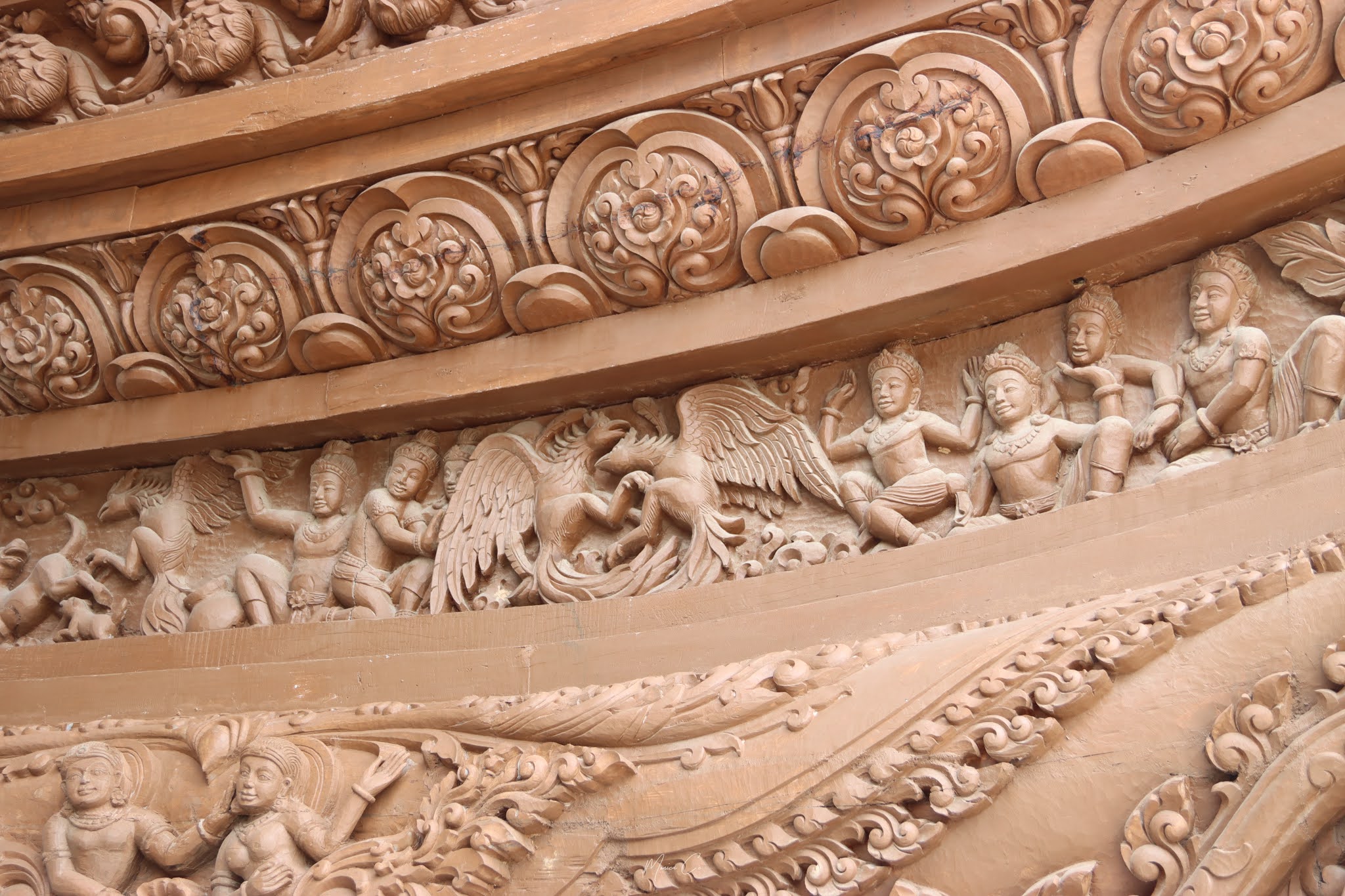
La costruzione richiama nello stile l'architettura religiosa tradizionale, ma in realtà segue altri canoni ed è realizzata completamente in legno, teak per la precisione e senza l'utilizzo di chiodi, solo di varie tipologie di incastri. I chiodi in realtà vengono utilizzati in alcune situazioni ma solo finché l'incastronon si è posizionato a dovere, dopo di che vengono rimossi.


L'idea di fondo da cui prende vita il progetto è mostrare che tutte le religioni portano all'unica verità, la decorazione del santuario sottolinea l'importanza delle filosofie religiose, in quanto esse contribuiscono alla stabilità del mondo insegnando alle persone ad evitare le intenzioni malvagie e promuovendo le buone azioni. Le diverse parti della costruzione sono ispirate alle diverse tradizioni artistiche e alle mitologie di Thailandia, Cambogia, Cina e India, in pratica sembra la sintesi artistica di quella ibridizzazione culturale teorizzata dall'antropologo Pattana Kitiarsa. Il risultato è una straordinaria opera d'arte alta 105 metri, costellata da centinaia e centinaia di personaggi e scene della tradizione religiosa e popolare del sud est asiatico. La pianta dell'edificio è a croce con i bracci di uguale lunghezza, la posizione rispetto al nord geografico è quella di una X. 

Il santuario indica la "verità", proponendo l'idea che la civiltà nasce da una combinazione di filosofie e religioni, e che la moralità del mondo deriva da queste idee filosofiche e religiose insieme all'arte. Il Santuario della Verità mira a riallineare la morale e i valori tradizionali e a promuovere la pace e l'armonia.

Secondo il suo progettista ci sono sette creatori: Cielo, Terra, Padre, Madre, Sole, Luna e Stelle. Ogni tema è rappresentato in tutto l'edificio. Le credenze orientali riconoscono spesso quattro componenti di una vita ideale: religione, filosofia, pace e vita reale. Volgendo lo sguardo verso il cielo si possono vedere queste idee rappresentate in cima alle guglie allungate.

Per raggiungere la perfezione di vita, gli uomini devono superare varie sfide, come le lotte tra il bene e il male, la devozione spirituale, le guerre globali, il crescente materialismo e l'abbandono della natura. Queste prove della vita sono illustrate attraverso la riproduzione di scene del Ramayana e del Mahabharata, due importanti racconti della tradizione orientale.


Ogni lato ha un suo portale ispirato appunto a diverse tradizioni, il più spettacolare è quello che riprende lo stile khmer della decorazione dei templi di Angkor wat. 


Per quanto ci si possa soffermare ad osservare i dettagli è praticamente impossibile memorizzare tutte le immagini, i personaggi, le scene riprodotte, come se l'opera in costante perfezionamento nella sua incompiutezza trasmettesse all'osservatore la consapevolezza dei suoi limiti e del limite del suo sguardo. 

In cima alla guglia più alta è collocato Phra Sri Ariya Metrai a cavallo, si tratta dell'ultima persona a raggiungere l'illuminazione e a diventare un Buddha nell'era attuale. Secondo la tradizione indù, si ritiene che si tratti di Vishnu che apparirà per porre fine al tempo presente e iniziare una nuova era.


L'interno dell'edificio, ancora largamente incompleto presenta quattro grandi sale decorate da bassorilievi alle pareti e statue. Il centro circolare ospita un reliquiario, e non è inusuale che le persone si fermino a pregare e a lasciare delle offerte, anche se non si tratta di un tempio.


Per agevolare la visita vengono organizzate delle visite guidate che si concludono nell'atrio dedicato alla famiglia ricordando la gratitudine che si deve avere per questa istituzione, basata sull'amore reciproco e la cura dell'altro.


Nello stesso ambiente sono conservate le immagini di Lek Viriyaphan e di sua moglie.


A livello personale sono ovviamente affascinata da tanta maestria artistica e abilità nella lavorazione del legno.

Non sono una esperta di arte contemporanea, quello che mi lascia perplessa è questa sorta di eccesso decorativo, a fronte di altre correnti contemporanee minimaliste o astrattiste sia locali sia internazionali. Sia il santuario della verità sia il tempio bianco di Chiang Rai sono installazioni artistiche accomunate dallo stesso horror vacui che mi appare simile al barocco italiano, pur ammirandone la spettacolarità rimango in dubbio sulla necessità di una tale produzione, più per il santuario della verità che per il tempio bianco... 
Sono comunque due opere che devono essere viste con i propri occhi perché qualsiasi descrizione non può essere sufficientemente esaustiva.


[ENGLISH VERSION]

 ...there are places, even here in Thailand, where I would never want to go for a variety of reasons, one of which is Pattaya, whose modern history is closely linked to the development of prostitution in this country. A place by the sea where the last reason for attraction is the sea, personally is not the place where I would like to go on holiday. 

It happens, however, that for some years now an extraordinary installation of contemporary art has been open to visitors in Pattaya, the construction of which began in 1981 but has not yet been completed and perhaps never will be. 

The title of the work is Sanctuary of truth, ปราสาทสัจธรรม (Prasat Satchatham), the brainchild of Lek Viriyaphan, a wealthy businessman who has already promoted visionary projects such as Muang Boran and the Erawan Museum in Bangkok.

The building is reminiscent of traditional religious architecture in style, but actually follows other canons and is made entirely of wood, teak to be precise, without the use of nails, just various types of joints. The nails are actually used in some situations but only until the joint is properly positioned, after which they are removed.

The basic idea behind the project is to show that all religions lead to the one truth, and the decoration of the sanctuary underlines the importance of religious philosophies, as they contribute to the stability of the world by teaching people to avoid evil intentions and promoting good deeds. The different parts of the construction are inspired by the different artistic traditions and mythologies of Thailand, Cambodia, China and India, in practice seeming to be the artistic synthesis of that cultural hybridisation theorised by the anthropologist Pattana Kitiarsa. The result is an extraordinary 105 metre high masterpiece, studded with hundreds and hundreds of characters and scenes from the religious and popular traditions of Southeast Asia. The plan of the building is in the shape of a cross with arms of equal length, its position relative to the geographical north is that of an X. 

The shrine stands for 'truth', proposing the idea that civilisation arises from a combination of philosophies and religions, and that the morality of the world derives from these philosophical and religious ideas together with art. The Shrine of Truth aims to realign morality and traditional values and to promote peace and harmony.

According to its designer there are seven creators: Heaven, Earth, Father, Mother, Sun, Moon and Stars. Each theme is represented throughout the building. Eastern beliefs often recognise four components of an ideal life: religion, philosophy, peace and real life. Looking up into the sky, one can see these ideas represented atop the elongated spires.

To achieve perfection in life, humans have to overcome various challenges, such as struggles between good and evil, spiritual devotion, global wars, increasing materialism and neglect of nature. These trials of life are illustrated through the reproduction of scenes from the Ramayana and the Mahabharata, two important tales of Eastern tradition.

Each side has its own portal inspired by different traditions, the most spectacular being the one that echoes the Khmer style of decoration in the temples of Angkor wat. 

No matter how much you look at the details, it is practically impossible to memorise all the images, characters and scenes reproduced, as if the opera, which is constantly being perfected in its incompleteness, is transmitting to the observer an awareness of its limits and the limits of his gaze. 

At the top of the highest spire stands Phra Sri Ariya Metrai on horseback, the last person to achieve enlightenment and become a Buddha in the present era. According to Hindu tradition, he is believed to be Vishnu who will appear to end the present time and begin a new era.

The interior of the building, still largely unfinished, has four large rooms decorated with bas-reliefs on the walls and statues. The circular centre houses a reliquary, and it is not unusual for people to stop and pray and leave offerings, even though it is not a temple.

To facilitate the visit, guided tours are organised, ending in the family atrium, recalling the gratitude one must have for this institution, based on mutual love and care for one another.

Images of Lek Viriyaphan and his wife are kept in the same room.

On a more personal level, I am obviously fascinated by such artistry and woodworking skills.

I am not an expert in contemporary art, but what puzzles me is this sort of decorative excess, compared with other contemporary minimalist or abstract currents, both local and international. Both the Sanctuary of Truth and the White Temple in Chiang Rai are art installations which share the same horror vacui, which seems to me similar to Italian Baroque. While admiring their spectacularity, I remain in doubt about the need for such a production, more so for the Sanctuary of Truth than for the White Temple... 
In any case, these are two masterpieces that must be seen with one's own eyes because any description cannot be sufficiently exhaustive.

mercoledì 2 dicembre 2020

WAT PHRATHAT PHA SORN KEAW - un tempio di straordinaria bellezza - a temple of extraordinary beauty


[SCROLL DOWN FOR ENGLISH]

 ...come prima meta, dopo questo lungo periodo di fermo forzato, ho scelto un tempio la cui immagine è abbastanza diffusa e conosciuta, mentre il luogo rimane non frequentato dai turisti stranieri e relativamente poco anche dai thai. 

Il Wat Prhathat Pha Sorn Keaw sorge in cima ad un colle, a 840 metri sul livello del mare, in mezzo alle montagne nei pressi dell'abitato di Khaem Som, lungo la strada che collega Phitsanulok a Petchabun. La zona viene anche chiamata "la Svizzera della Thailandia" proprio per il paesaggio montano e, tra l'altro, proprio nei pressi del tempio potrete mangiare in un'autentica baita svizzera.  La zona negli anni ha visto proliferare l'offerta alberghiera ma per qualche strano motivo è praticamente assente un servizio di trasporto pubblico e quasi inesistente quello privato. Ma cominciamo dall'inizio. Da Chiang Mai per raggiungere il luogo più prossimo al tempio il mezzo migliore è l'autobus e la tratta è Chiang Mai - Lom Sak. Su indicazione del personale dell'albergo dove ho prenotato abbiamo chiesto di scendere al Hue Pai Market e comunque il personale del bus non riusciva a capire e ho mostrato loro la foto del tempio. Di fatto non si tratta di una fermata, ma di un favore che vi fanno, risparmiandovi il dover trovare poi un transfer da Lom Sak a Khaem Som. Quest'ultimo è un centro abitato o meglio un gruppo di costruzioni lungo la strada che collega Phitsanulok a Petchabun. Il tempio è a circa due chilometri, ben visibile dalla strada, per vostra fortuna, perchè incredibilmente manca qualsiasi segnaletica che vi indichi la direzione per raggiungerlo. Per il resto, nel caso abbiate la fortuna di avere una camera con vista verso la montagna, l'atmosfera è davvero piacevole, l'aria molto fresca e pulita e vedere a distanza il tempio illuminato è davvero suggestivo. 


La mattina abbastanza presto ci siamo rivolti alla reception per avere indicazioni per raggiungere il tempio. La giovane incaricata non parla inglese e si destreggia con Google translator per comunicarci che l'unica modalità è noleggiare una moto o un'auto. Chiediamo quanto costa affittare un'auto con autista e dopo varie telefonate ci informa che la richiesta è di 500 bhat solo andata. La cifra ci sembra davvero esagerata per meno di due chilometri, tanto che decidiamo di avviarci a piedi. Mentre camminiamo veniamo superati da diversi Song-Teaw, i classici furgoni scoperti con il retro adibito al trasporto passeggeri, proviamo a fermarli e al terzo tentativo riusciamo a farci caricare. All'arrivo l'autista rifiuta di essere pagato, sorridendo, non posso fare a meno di sfoggiare il mio thai per benedirlo. 


Il wat phrathat pha sorn keaw è un monastero e centro di meditazione di recente costruzione, la fondazione è del 2004. Nonostante abbia fatto diverse ricerche non sono riuscita a risalire al nominativo dell'autore del visionario progetto. Come ogni tempio thailandese anche questo è composto da vari edifici e strutture con diverse finalità. Il più spettacolare è formato dalla scultura raffigurante i cinque buddha seduti, nella posizione della meditazione, in fila dal più piccolo al più grande. Lungo le scalinate di accesso sono posizionate delle sculture in metallo, che formano cerchi concentrici, dove sono collocate delle sfere di acciaio, una rappresentazione forse dell'universo o comunque con un richiamo al cosmo. 


La pavimentazione della terrazza antistante presenta vari mosaici, purtroppo la presenza di molti devoti non consente una visione completa del disegno.


La base di questa incredibile opera è su due piani e contiene due sale per la preghiera. Una delle quali contiene un inusuale, ma direi che qui nulla è usuale, buddha sdraiato con elementi decorativi in rosa. 


Divisa da una stretta strada è collocata una pagoda la cui forma è ispirata al fiore di loto, che si sviluppa su sette livelli.


E mentre le statue vanno viste a distanza per avere la percezione della loro dimensione e maestosità, la pagoda va goduta nel dettaglio con uno sguardo ravvicinato. 


L'intera struttura e la pavimentazione esterna sono ricoperte da cinque milioni di tessere da mosaico. 


Le pareti esterne sono decorate con migliaia di pezzi di servizi di porcellana, tazzine, ciotole, coperchi, piatti...con effetti colorati caleidoscopici, che a molti ricordano lo stile dello spagnolo Gaudì.


Salire i vari livelli della pagoda consente anche di avere dei punti di osservazione particolari sulle altre attrazioni del sito e in particolare, ovviamente, sulle statue del buddha.


Trattandosi di un monastero non possono mancare gli alloggi per i monaci e ancora una volta si rimane colpiti dall'architettura del tutto originale. Abitualmente nei monasteri thai gli alloggi dei monaci sono piccole strutture in legno, bungalow essenziali per consentire uno spazio privato ed austero che favorisca il riposo, lo studio, la meditazione. Qui la struttura ricorda un condominio, con uno stile forse più da nord Europa che non da sud est asiatico.


La spettacolarità di questo tempio è in realtà assolutamente connessa alla bellezza del panorama circostante, non a caso gli edifici principali sono dotati di terrazze che invitano alla contemplazione mentre lo sguardo si perde nelle varie sfumature di verde delle montagne e l'azzurro davvero carico del cielo nell'inverno thailandese. 


Il timore è che con il passare del tempo una maggiore presenza turistica possa determinare la fioritura di ulteriori strutture turistiche e non, finendo con la deturpazione del paesaggio.

In questo senso è affascinante e, allo stesso tempo, inquietante vedere il progetto in via di realizzazione di un gigantesco buddha sdraiato lungo più di cento metri e adagiato sopra un edificio a più piani.


Nelle immediate vicinanze del tempio sono sorti vari ristoranti, noi ci siamo fermati in un bar bistrò, Piney, molto simile ad una baita svizzera, con una terrazza affacciata sul panorama davvero suggestivo.


Indicazioni utili: da Chiang Mai è possibile raggiungere Khaem Son in autobus con la compagnia Phet Prasert il loro sito è tutto in thailandese ma potete trovare il QR code per la chat su Line e avere assistenza in lingua inglese. Nel nostro caso è stata utilissima per avere indicazioni per il rientro a Chiang Mai. Per la prenotazione dei biglietti consiglio di utilizzare il sito 12go.asia . 

All'andata come ho già scritto potete chiedere di scendere nella zona più vicina al tempio, ma al ritorno non è previsto un analogo servizio di pick-up e dovrete raggiungere Lom Sak. Per questo transfer consiglio di rivolgervi al negozio vicino al 7-eleven, che vende attrezzature da campeggio con camouflage paramilitare e gestisce anche un baracchino di street-food. Abbiamo ottenuto un passaggio fino a Lom Sak per 350 bhat. Ma sarà necessario poter comunicare in thai in quanto la titolare non parla inglese. A questo proposito è sicuramente frustrante non riuscire a trovare personale in grado di comunicare in lingua inglese, ma considerando che nei due giorni trascorsi in zona non abbiamo visto altri farang è comprensibile come ancora non venga avvertita l'esigenza di avere personale più qualificato.

Qui potete trovare le oltre 300 foto che ho scattato in occasione di questo viaggio:

[ENGLISH VERSION]

...as my first destination, after this long period of forced rest, I have chosen a temple whose image is quite widespread and well known, while the place remains not frequented by foreign tourists and relatively little even by Thai people. 

The Wat Prhathat Pha Sorn Keaw rises on top of a hill, 840 metres above sea level, in the middle of the mountains near the village of Khaem Som, along the road that connects Phitsanulok to Petchabun. The area is also called "the Switzerland of Thailand" because of the mountain landscape and, among other things, right near the temple you can eat in an authentic Swiss chalet.  The area has seen a proliferation of hotels over the years, but for some strange reason there is practically no public transport service and almost no private one. But let's start at the beginning.  From Chiang Mai to the nearest place to the temple the best means of transport is by bus and the route is Chiang Mai - Lom Sak. On the indication of the staff of the hotel where I booked we asked to get off at the Hue Pai Market and anyway the bus staff couldn't understand and I showed them the photo of the temple.In fact it is not a stop, but a favour they do you, saving you the trouble of having to find a transfer from Lom Sak to Khaem Som.  The latter is an inhabited centre or rather a group of buildings along the road from Phitsanulok to Petchabun. The temple is about two kilometres away, well visible from the road, fortunately for you, because incredibly it lacks any sign to show you the direction to reach it. For the rest, in case you are lucky enough to have a room with a view towards the mountain, the atmosphere is really pleasant, the air is very fresh and clean and seeing the illuminated temple from a distance is really suggestive. 

Early in the morning we turned to the front desk for directions to the temple. The young lady in charge does not speak English and juggles with Google translator to tell us that the only way is to rent a motorbike or a car. We ask how much it costs to rent a car with driver and after several phone calls she informs us that the request is 500 bhat one way. The cost seems to us really exaggerated for less than two kilometres, so much so that we decide to go on foot. As we walk we are overtaken by several Song-Teaw, the classic open van with the back used for passenger transport, we try to stop them and on the third attempt we manage to get loaded. On arrival the driver refuses to get paid, smiling, I can't avoid showing off my Thai to bless him. 

The wat phrathat pha sorn keaw is a newly built monastery and meditation centre, founded in 2004. Although I have made several researches I have not been able to trace the name of the author of the visionary project. Like every Thai temple, this one is composed of various buildings and structures with different purposes. The most spectacular one is formed by the sculpture representing the five Buddhas seated, in the meditation position, in a row from the smallest to the largest. Along the access stairs there are metal sculptures, which form concentric circles, where steel spheres are placed, perhaps a representation of the universe or in any case with a reference to the cosmos. 


The pavement of the terrace in front of it has various mosaics, unfortunately the presence of many devotees does not allow a complete view of the design.

The base of this incredible work is on two floors and contains two prayer halls. One of them contains an unusual, but I would say that nothing is usual here, Buddha lying with decorative elements in pink. 

Divided by a narrow street is a pagoda whose shape is inspired by the lotus flower, which develops on seven levels.

And while the statues have to be seen from a distance to get the perception of their size and majesty, the pagoda has to be enjoyed in detail with a close look. 

The entire structure and the outdoor pavement are covered with five million mosaic tiles. 

The external walls are decorated with thousands of pieces of porcelain services, cups, bowls, lids, plates... with kaleidoscopic coloured effects, which remind many of the style of the Spanish Gaudi.

Going up the various levels of the pagoda also allows you to have particular observation points on the other attractions of the site and in particular, of course, on the Buddha statues.

Since it is a monastery, there is no shortage of accommodation for the monks and once again one is struck by the completely original architecture. Usually in Thai monasteries the monks' lodgings are small wooden structures, essential bungalows to allow a private and austere space that facilitates rest, study and meditation. Here the structure is reminiscent of a condominium, with a style perhaps more from northern Europe than from south-east Asia.

The spectacularity of this temple is actually absolutely connected to the beauty of the surrounding landscape, it is no coincidence that the main buildings are equipped with terraces that invite contemplation while the gaze is lost in the various shades of green of the mountains and the blue really charged sky in the Thai winter. 

The fear is that with the passing of time a greater tourist presence may determine the flowering of further tourist facilities and not, ending with the disfigurement of the landscape.

In this sense it is fascinating and, at the same time, disturbing to see the project in progress of a gigantic Buddha lying more than one hundred metres long on top of a multi-storey building.

In the immediate vicinity of the temple several restaurants have sprung up, we stopped in a bistro bar, Piney, very similar to a Swiss chalet, with a terrace overlooking the really suggestive panorama.

Useful indications: from Chiang Mai it is possible to reach Khaem Son by bus with Phet Prasert company their website is all in Thai but you can find the QR code for chat on Line and have assistance in English. In our case it was very useful to get directions back to Chiang Mai. For ticket reservation I suggest to use 12go.asia

On the outward journey, as I have already written, you can ask to get off in the area closest to the temple, but on the return journey there is no similar pick-up service and you will have to reach Lom Sak. For this transfer I suggest you go to the shop near the 7-eleven, which sells camping equipment with paramilitary camouflage and also runs a street-food shop. We got a transfer to Lom Sak for 350 bhat. But you will need to be able to communicate in Thai as the owner does not speak English. In this regard it is certainly frustrating not being able to find staff able to communicate in English, but considering that in the two days spent in the area we have not seen other farang it is understandable how the need for more qualified staff is not yet felt.

Here you can find the over 300 photos I took on this trip:


giovedì 24 settembre 2020

TRA SOGNI ESOTICI E REALTA' - BETWEEN EXOTIC DREAMS AND REALITY

 [SCROLL DOWN FOR ENGLISH]


Nell'immaginario onirico di molte persone credo sia presente il topos di trascorrere un periodo in un paese esotico, nell'ozio assoluto, mentre graziose figure si prendono cura del vostro corpo, lavandolo e profumandolo, per poi offrivi gradite pietanze mentre si è languidamente sdraiate e seminude... Ecco questo è quel che è accaduto  a me per quindici giorni, ma non inviadetemi: ero in ospedale, quindici giorni senza poter scendere dal letto, nel frattempo tre interventi per via di una ustione di secondo grado profonda al piede destro. 


Ormai sono alla fine di questo percorso di guarigione fisica ma inevitabilmente le lunghe ore trascorse tra flebo e medicazioni hanno provocato un intenso lavoro di introspezione per trovare le risorse che mi consentissero di sopravvivere alla morte per noia. Un aiuto ovviamente è arrivato dal poter tenere i contatti tramite i diversi social, la condivisione delle stories su Instagram, i post su Facebook, ecc... E non posso negare che sentire così tante persone che in qualche modo sono state partecipi delle mie avventure è stato motivo di consolazione nei momenti più difficili. Le chiamate da Miami, dall'Italia, dalla Spagna e le chattate fino a tarda notte sono state di grande aiuto, come ovviamente le visite degli amici e colleghi, per non dire poi di chi ha risposto alla mia richieste di affiancarmi nei momenti post-interventi. 

Nelle ore di solitudine ho sempre cercato di guardare avanti, senza dedicare troppo spazio al ricordo del momento dell'incidente. Tanto che l'unico sogno che ricordo di aver fatto è stato il momento in cui riprendevo il motorino con il piede ancora fasciato e, sorprendendomi di non sentire dolore, partivo per andare a fare la medicazione in ospedale...proiettata quindi a recuperare la normalità ma consapevole di dover ancora prendermi cura delle mie ferite!

Ho riflettuto anche sul fatto che tutto questo è accaduto proprio nel momento in cui avevo raggiunto una certa resistenza fisica e capacità di affrontare anche dei percorsi di trekking abbastanza impegnativi. Ora uno degli obiettivi ovviamente è ripartire a mettere un piede avanti all'altro e raggiungere le prossime mete, prima fra tutte il "tempio nascosto"...

Ormai sono sette anni che sono tornata a vivere in Thailandia, n questi anni non ho mai voluto cimentarmi in un ritiro vipassana nonostante ce ne siano di molto accessibili. Dopo questa esperienza mi ritengo esonerata e sono felice di aver conservato la sanità mentale. 


[ENGLISH VERSION]

In the dreamlike imagination of many people I think there is the topos of spending a period of time in an exotic country, in absolute idleness, while pretty figures take care of your body, washing it and perfuming it, and then offering you pleasant food while you are languidly lying half-naked... This is what happened to me for fifteen days, but don't envy me: I was in hospital, fifteen days without being able to get out of bed, in the meantime three operations because of a second degree burn deep in my right foot. 

By now I am at the end of this physical healing process, but inevitably the long hours spent between phlebo and dressings have caused an intense work of introspection to find the resources that would allow me to survive death out of boredom. Obviously, help came from being able to keep in touch through different social networks, sharing stories on Instagram, Facebook posts, etc... And I cannot deny that hearing so many people who have somehow been part of my adventures has been a source of consolation in the most difficult moments. The calls from Miami, Italy and Spain and the late-night chats were of great help, as were the visits from friends and colleagues, not to mention those who responded to my request to join me in the post-intervention moments. 

During the hours of solitude I always tried to look ahead, without dedicating too much space to the memory of the moment of the accident. So much so that the only dream I remember having had was the moment when I was taking my moped back with my foot still bandaged and, surprised not to feel any pain, I left to go and do the dressing in the hospital...projected to recover normality but aware that I still had to take care of my wounds!

I also reflected on the fact that all this happened at the very moment when I had reached a certain physical endurance and the ability to face quite demanding trekking routes. Now one of the objectives of course is to start again to put one foot in front of the other and reach the next destinations, first of all the "hidden temple"...

It's been seven years since I returned to live in Thailand, and in these years I have never wanted to try my hand at a vipassana retreat, even though there are some very accessible ones. After this experience I consider myself exonerated and I am happy to have kept my mental health. 

giovedì 23 luglio 2020

SI QUEY - CANNIBALE E CAPRO ESPIATORIO - SI QUEY - CANNIBAL AND SCAPEGOAT


[SCROLL DOWN FOR ENGLISH]
 
E' il 1958, Somboon ha otto anni e vive nella provincia di Rayong. Un giorno si allontana da casa per andare a comprare frutta e verdura. Non vedendolo rientrare il padre e alcuni parenti cominciano a cercarlo, si recano ovviamente subito presso l'orto di Si Quey dove il bambino avrebbe dovuto fare i suoi acquisti. L'uomo, un cinese della provincia di Guangdong, nella Cina meridionale, parla poco il thai ma fa capire di non avere idea di dove sia Somboon e mentre parla si appresta a bruciare dei tronchi e delle foglie secche. Ad un tratto il padre del bambino riconosce nel falò una piccola gamba! Ovviamente Si Quey viene fermato e i resti del bambino recuperati ma sono privi di alcuni organi: cuore, reni e fegato. 
Si procede quindi ad interrogare il reo confesso con l'aiuto di un interprete. Si Quey rivela di aver mangiato gli organi del bambino. Poi secondo le fonti di polizia confesserà spontaneamente di aver già ucciso altri cinque bambini i cui corpi erano stati ritrovati senza gli organi. Il primo delitto risaliva al 1954 e gli altri si erano succeduti nell'arco di quattro anni, sempre in città diverse e anche distanti. Raccontò di aver imparato da un eremita che mangiare gli organi gli avrebbe permesso di ringiovanire e in generale avrebbe fatto bene alla sua salute. 

Il caso ovviamente finì con l'occupare le prime pagine dei giornali e suscitò una forte impressione nell'opinione pubblica. D'altra parte c'è da considerare che la Seconda Guerra Mondiale era terminata da poco e la diffidenza nei confronti dei cinesi era quanto mai vicina ad una aperta ostilità. La Thailandia era sotto la sfera di infuenza degli Stati Uniti soprattutto come baluardo unico nella penisola indocinese di resistenza contro la diffusione del comunismo. Insomma anche se i thailandesi non erano condizonati dalla Chiesa Cattolica o dalla Democrazia Cristiana avevano comunque metabolizzato l'idea dei comunisti che mangiano i bambini e Si Quey si assunse il ruolo di rendere concreta tale leggenda.

Il processo fu molto rapido e ovviamante la condanna fu la pena capitale. Si Quey venne fucilato nel settembre del 1959, aveva 32 anni. Ma la sua storia non finisce con la sua morte. Per motivi scientifici il suo corpo venne imbalsamato e successivamente esposto in una teca nel museo forense del Siriraj Hospital di Bangkok, costituendone una delle atrazioni principali. 
Nello stesso tempo la sua sinistra fama crebbe a tal punto da diventare l'equivalente del nostro "uomo nero" invocato per far paura ai bambini, le mamme thailandesi usano il suo nome come deterrente per figli troppo vivaci. 

In tempi recenti è poi iniziata una campagna per restituire dignità a Si Quey, ritenendo l'esposizione del suo corpo una violazione dei diritti umani. La petizione ha ricevuto decine di migliaia di firme e alla fine la direzione del museo ha provveduto a sostituire la targhetta che lo indicava come "cannibale". Successivamente il movimento di opinione è tornato a chiedere il riconoscimento di ulteriori diritti per la salma del pluriomicida fino ad ottenere delle esequie e la cremazione secondo la tradizione buddista thailandese. 

Il rito funebre si è svolto oggi giovedì 23 luglio 2020, vi hanno partecipato molte guardie penitenziarie, rappresentanti del museo e alcuni civili che avevano conosciuto Si Quey in vita e che giurano sulla sua innocenza. Gli abitanti di Thap Sakae, in provincia di Prachuap Kiri Khan, luogo del primo omicidio, hanno chiesto di poter conservare le sue ceneri presso un tempio locale.

A distanza di 60 anni forse il suo nome non ha più un suono così sinistro e le mamme non potranno più usarlo avendo perso molto della sua spaventosa forza. 

Direi che il sistema legale ha fallito", dice la professoressa Wasana Wongsurawat, storica dell'Università Chulalongkorn di Bangkok. A Si Quey è stato negato il giusto processo".
In molti, o forse in tutti gli omicidi che gli sono stati imputati, aggiunge la storica, l'immigrato cinese è stato probabilmente un comodo capro espiatorio per i crimini commessi da altri.
La Thailandia, fedele alleata degli Stati Uniti, all'epoca era in preda all'isteria anticomunista, e il regime militare duro del Paese considerava gli immigrati provenienti dalla Cina come possibili rivoluzionari clandestini che cercavano di promuovere il maoismo. Accusati di crimini come l'incendio doloso, i sospetti furono spesso giustiziati sommariamente. 
"Si Quey ha subito un destino simile. Era [ritratto come] questo spaventoso comunista cinese con i denti marci", dice Wasana, un'autorità sulla storia del popolo cinese in Thailandia.
"I lavoratori migranti cinesi di allora erano molto simili ai lavoratori migranti del Myanmar e della Cambogia di oggi" - emarginati e a rischio di essere condannati con le prove più inconsistenti, dice. [South China Morning Post]
 

[ENGLISH VERSION]

 It's 1958, Somboon is eight years old and lives in Rayong Province. One day he leaves home to go buy fruits and vegetables. Not seeing him return, his father and some relatives start looking for him, and they go immediately to the orchard of Si Quey where the child should have been shopping. The man, a Chinese man from Guangdong province in southern China, speaks little Thai but makes it clear that he has no idea where Somboon is and while he is talking he is preparing to burn some trunks and dry leaves. Suddenly the child's father recognizes a small leg in the bonfire! Obviously Si Quey is stopped and the remains of the child are recovered but they are missing some organs: heart, kidneys and liver. 
The offender is then interrogated and confessed with the help of an interpreter. Si Quey reveals that he ate the child's organs. Then, according to police sources, he spontaneously confesses to having already killed five other children whose bodies had been found without organs. The first crime dates back to 1954 and the others had been committed over a period of four years, always in different and distant cities. He said he had learned from a hermit that eating the organs would enable him to rejuvenate and generally be good for his health. 

The case obviously ended up occupying the front pages of the newspapers and made a strong impression on public opinion. On the other hand, it must be considered that the Second World War had just ended and the distrust towards the Chinese was very close to open hostility. Thailand was under the influence of the United States mainly as the only bulwark in the Indo-Chinese peninsula of resistance against the spread of communism. In short, even if the Thai people were not conditioned by the Catholic Church or the Democrazia Cristiana, they had however metabolized the idea of the communists eating children and Si Quey took on the role of making this legend concrete.

The trial was very quick and the sentence was capital punishment. Si Quey was shot in September 1959, he was 32 years old. But his story does not end with his death. For scientific reasons his body was embalmed and then exhibited in a case in the forensic museum of the Siriraj Hospital in Bangkok, which is one of the main attractions. 
At the same time his sinister fame grew to such an extent that he became the equivalent of our "black man" invoked to frighten children, Thai mothers use his name as a deterrent for children who are too lively. 

In recent times, a campaign to restore dignity to Si Quey has begun, considering the exposure of his body a violation of human rights. The petition received tens of thousands of signatures and in the end the museum management replaced the plaque indicating him as a 'cannibal'. Subsequently, the opinion movement came back to demand further rights for the body of the multiple murderer until a funeral and cremation according to Thai Buddhist tradition. 

The funeral rite took place today Thursday, July 23, 2020, with the participation of many prison guards, representatives of the museum and some civilians who had known Si Quey while he was alive and who swore his innocence. The inhabitants of Thap Sakae, in the province of Prachuap Kiri Khan, the site of the first murder, asked to be allowed to keep his ashes at a local temple.

After 60 years, his name may no longer sound so sinister and mothers will no longer be able to use it, having lost much of its frightening power. 

I would say that the legal system has failed, says Professor Wasana Wongsurawat, historian at Chulalongkorn University in Bangkok. Si Quey has been denied a fair trial.
In many, or perhaps in all the murders he has been accused of, the historian adds, the Chinese immigrant was probably a convenient scapegoat for the crimes committed by others.
Thailand, a loyal ally of the United States, was in the grip of anti-communist hysteria at the time, and the country's harsh military regime regarded immigrants from China as possible illegal revolutionaries trying to promote Maoism. Accused of crimes such as arson, suspects were often summarily executed. 
"Si Quey suffered a similar fate. He was [portrayed as] this frightening Chinese communist with rotten teeth," says Wasana, an authority on the history of the Chinese people in Thailand.
"Chinese migrant workers at the time were very similar to migrant workers in Myanmar and Cambodia today" - marginalized and at risk of being convicted with the most flimsy evidence, she says. [South China Morning Post]


MONACHESIMO FEMMINILE: LA GOCCIA CHE SCAVA LA ROCCIA - FEMININE MONASTICISM: THE DROP THAT HOLDS THE ROCK

  [SCROLL FOR ENGLISH] In Thailandia le bikkhhuni esistono e stanno crescendo. Il turista medio occidentale quando immagina o ricorda un vi...