martedì 19 novembre 2019

WAT THUNG KISUA, SALVADANAI E RICORDI - WAT THUNG KISUA, PIGGY BANKS AND MEMORIES


[SCROLL DOWN FOR ENGLISH]
Capita a volte di ricordarsi di luoghi visitati anni fa, ma non ricordando il nome ed essendoci arrivata seguendo amici che già conoscevano la strada si dispera dal poterli ritrovare. Ma si viene soccorsi dalla funzione "ricordi" di Facebook e poi dalle foto caricate su Google. Insomma non essendo una nativa digitale non potete immaginare  quale sia stato il mio stupore quando, dopo aver cliccato su una delle foto, mi è comparsa la mappa di Google...insomma dopo mesi che cercavo di capire come ritrovare questo bel tempio in pochi secondi mi ritrovo il percorso in mano direttamente dal mio smartphone! Tutto questo per farvi sapere come sono riuscita a tornare dopo tre anni esatti al wat thung kisua, un piccolo tempio sull'argine del mae kuang, corso d'acqua ad est di Chiang Mai.
Nel corso della prima visita abbiamo avuto modo di incontrare un simpatico monaco che ad alcuni fece l'oroscopo e poi fu molto generoso di consigli in merito a dove fare dei Sak Yant e, grazie alle sue indicazioni, nei giorni successivi visitammo Wat Mae Ta Khrai a Mae On. Il monaco dopo gli oroscopi ci diede anche ad ognuno un amuleto creato da lui da collocare sopra la porta di ingresso di casa in modo di tenere lontane le negatività e proteggere gli abitanti. Poi prima di lasciarci ci regalò ad ognuno un salvadanaio, di quelli classici a forma di maialino. Devo ammettere che uno dei motivi che mi spingevano a tornare in questo tempio era capire se fosse tempo di rompere il salvadanaio e nella mia mente mi sono immaginata che nel caso avrei sicuramente incontrato il monaco e mi avrebbe regalato un altro salvadanaio e questo sarebbe stato il segno che fosse giunto il momento di rompere il precedente. Sono arrivata nel primo pomeriggio, la giornata era splendida e come sempre mi sono goduta anche il tragitto che una volta lasciata la superstrada e il centro abitato diventa una piccola strada di campagna tra il verde dei campi di riso e della vegetazione spontanea che costeggia il fiume. Il tempio è molto piccolo, stretto nello spazio tra la strada e il fiume, ma a lato è presente un cantiere quindi si sta espandendo.
Ho visitato di nuovo il tempio e scattato alcune foto, poi mi sono fermata un po' sull'ampio terrazzo affacciato sul fiume, la vista dell'acqua ha sempre una funzione rilassante. Il tempio ha una sala delle ordinazioni completamente in legno e un chedi non troppo grande, nel cui perimetro le donne non possono entrare.

E' stata una gita piacevole davvero. Il monaco non c'era, quindi ancora per un po' il maialino è salvo

[ENGLISH VERSION]

It happens sometimes to remember places visited years ago, but not remembering the name and being there following friends who already knew the road despairs of being able to find them. But you are helped by the "memories" function of Facebook and then by the photos uploaded on Google. In short, not being a digital native you can't imagine what my amazement was when, after clicking on one of the photos, I was shown the Google map ... in short, after months trying to figure out how to find this beautiful temple in a few seconds, I find the path in my hand directly from my smartphone! All this to let you know how I managed to return after three years exactly to wat thung kisua, a small temple on the embankment of mae kuang, a stream in the east of Chiang Mai. During the first visit we had the opportunity to meet a nice monk who made some horoscopes and then was very generous with advice on where to do Sak Yant and, thanks to his directions, in the following days we visited Wat Mae Ta Khrai in Mae On.
The monk after the horoscopes also gave each one an amulet created by him to be placed above the front door of the house in order to keep away the negativity and protect the inhabitants. Then, before leaving us, he gave each one of us a piggy bank, the classic ones in the shape of a piglet. I have to admit that one of the reasons that pushed me to return to this temple was to understand if it was time to break the piggy bank and in my mind I imagined that in case I would surely meet the monk and would give me another piggy bank and this would be the sign that it was time to break the previous one. I arrived in the early afternoon, the day was wonderful and as always I also enjoyed the route that once left the highway and the town becomes a small country road between the green fields of rice and spontaneous vegetation that runs along the river.
The temple is very small, narrow in the space between the road and the river, but to the side there is a construction site so it is expanding. I visited the temple again and took some photos, then I stopped a little 'on the large terrace overlooking the river, the view of the water always has a relaxing function. The temple has an ordination hall completely in wood and a chedi not too big, in whose perimeter women can not enter. It was a really pleasant trip. The monk was not there, so for a while 'the piglet is safe

domenica 10 novembre 2019

Exodus Déjà-Vu Photography Exhibition


L'immagine può contenere: 2 persone

(SCROLL DOWN FOR ENGLISH)

Ieri ero in centro e avendo un po' di tempo ho deciso di andare alla House of Photography che spesso ospita mostre originali ed interessanti. Quella in corso e aperta fino al 30 Novembre si intitola "Exodus Déjà-Vu Photography Exhibition", con opere dei fotografi Roland NEVEU, Greg CONSTANTINE, Suthep KRITSANAVARIN, Issa TOUMA, Sergey PONOMAREV, Rahman ROSLAN, Coskun ARAL, Jean CHUNG, Yalda MOAEIRY, Guillermo ARIAS, Fabiola FERRERO, Atilgan OZDIL.Nessuna descrizione della foto disponibile.  E devo dire che è una mostra orribile, nel senso etimologico del termine, suscita orrore, non lasciando indifferente il visitatore. Il tema sono gli esodi, le migrazioni di massa a causa delle guerre, dell'odio o di calamità. Il titolo è una magnifica sintesi del contenuto Exodus Déjà-Vu, esodo già visto. Osservando le fotografie inevitabilmente si è spinti a riflettere su a quanti esodi abbiamo assistito, dall'Asia, all'Europa, alle Americhe e all'Africa... Popolazioni con nomi diversi rohingya, cambogiani, siriani, curdi, che hanno vissuto tutti la tragica necessità di lasciare la propria casa, il proprio paese, il proprio futuro a causa di conflitti. Fotografare un esodo significa ritrarre persone, donne, uomini, bambini e l'orrore nei loro sguardi... Guardando quelle immagini si viene colpiti dalla sofferenza, ritratta in quel preciso istante, ma di cui si vorrebbe conoscere non tanto il percorso che ha condotto fino a lì le persone ritratte ma soprattutto quale sia stata la loro storia successiva... A colpire nel profondo sono poi i volti dei bambini, con occhi spaventati e espressioni indurite da esperienze troppo dolorose per i loro pochi anni, tutti loro hanno espressioni da adulti. a tutti loro è stata rubata l'infanzia.
 L'immagine può contenere: 3 persone, persone che sorridono, testo e spazio all'aperto(ENGLISH VERSION)
I was downtown yesterday and having some time I decided to go to the House of Photography which often hosts original and interesting exhibitions. The one in progress and open until November 30th is called "Exodus Déjà-Vu Photography Exhibition", with works by photographers Roland NEVEU, Greg CONSTANTINE, Suthep KRITSANAVARIN, Issa TOUMA, Sergey PONOMAREV, Rahman ROSLAN, Coskun ARAL, Jean CHUNG, Yalda MOAEIRY, Guillermo ARIAS, Fabiola FERRERO, Atilgan OZDIL.  
Nessuna descrizione della foto disponibile.And I must say that it is a horrible exhibition, in the etymological sense of the term, it provokes horror, not leaving the visitor indifferent. The theme is exodus, mass migration due to war, hatred or calamity. The title is a magnificent synthesis of the content Exodus Déjà-Vu, exodus already seen. Looking at the photographies, one is inevitably driven to reflect on how many exodus we have seen, from Asia to Europe, the Americas and Africa... People with different names: Rohingya, Cambodians, Syrians, Kurds, all of whom have experienced the tragic need to leave their homes, their countries, their futures because of conflicts. Photographing an exodus means portraying people, women, men, children and the horror in their eyes... Looking at those images you are struck by the suffering, portrayed at that precise moment, but of which you would like to know not so much the path that led up to there the people portrayed but especially what was their next story ... The faces of the children are also deeply struck, with frightened eyes and expressions hardened by experiences too painful for their few years, all of them have adult expressions. 

venerdì 1 novembre 2019

PA CHOR - CAMMINARE 5 MILIONI DI ANNI WALKING 5 MILIONS OF YEARS


[SCROLL DOWN FOR ENGLISH]
Vivendo a Chiang Mai capita di vedere indicazioni o immagini di Pa Chor, che si trova ad una cinquantina di chilometri di distanza, all'interno del parco nazionale di Mae Wang, facilmente raggiungibile in motorino. Gli ultimi chilometri sono molto piacevoli tra lievi e verdi colline fino a raggiungere l'ingresso del parco. Il biglietto di ingresso per gli stranieri adulti è di 100 bhat. Dall'entrata si prosegue ancora per qualche chilometro fino a raggiungere il parcheggio superiore da cui si accede ad una terrazza affacciata sulla vallata.

Qui c'è anche un punto ristoro, dove rinfrescarvi al termine della visita.
A sinistra della terrazza c'è l'accesso alla scalinata per raggiungere il sentiero e altre scalinate fino ad arrivare di fronte a questa incredibile formazione rocciosa, un muro scanalato, fino a formare una sorta di strette colonne, con vari livelli fino ad un'altezza di 30 metri.
Il sito ha una storia di 5 milioni di anni e si è formato a causa dei meccanismi di erosione provocati dallo scorrere del fiume Ping e del vento. Nel tempo il Ping ha cambiato completamente il suo corso che ora si trova ad una distanza di circa dieci chilometri. La vista è davvero spettacolare e per quanto mi riguarda unica.
Sul bordo superiore spiccano alcuni enormi alveari, simili a quelli già visti su alcune statue del Buddha. Posso solo immaginare quanto possa essere buono quel miele davvero selvatico. Poi si prosegue ancora camminando in uno stretto sentiero, il greto del fiume ormai asciutto ma che durante la stagione delle piogge sicuramente torna ad ospitare un flusso d'acqua.


Poi il percorso riporta alla scalinata di accesso. Lungo il sentiero sono posizionate delle panchine e degli ombrelloni per riprendere fiato, la distanza tra il punto di accesso e la parete non è molta, circa 900 metri, ma affrontare scalinate nel caldo umido puo' essere abbastanza faticoso.

Pero' soltanto alla fine mi sono accorta del cartello con cui si avvisa chi soffre di ipertensione a valutare bene se sia il caso di affrontare la visita.


[ENGLISH VERSION]

Living in Chiang Mai you can see signs or images of Pa Chor, which is located about fifty kilometres away, within the national park of Mae Wang, easily accessible by scooter. The last kilometres are very pleasant between gentle and green hills until you reach the entrance to the park. The entrance ticket for foreign adults is 100 bhat. From the entrance you continue for a few more kilometres until you reach the upper parking lot from which you access a terrace overlooking the valley. Here there is also a rest area, where you can refresh yourself at the end of the visit.
To the left of the terrace there is the access to the staircase to reach the path and other staircases until you get in front of this incredible rock formation, a grooved wall, to form a sort of narrow columns, with various levels up to a height of 30 meters. The site has a history of 5 million years and was formed due to the mechanisms of erosion caused by the flow of the river Ping and the wind. Over time, the Ping has completely changed its course, which is now at a distance of about ten kilometres. The view is really spectacular and as far as I'm concerned unique.
On the upper edge stand out some huge hives, similar to those already seen on some statues of the Buddha. I can only imagine how good that really wild honey can be. Then we continue walking along a narrow path, the river bed now dry but that during the rainy season certainly returns to host a flow of water.
Then the path leads back to the access staircase. Along the path there are benches and umbrellas to catch your breath, the distance between the access point and the wall is not much, about 900 meters, but facing stairs in the humid heat can be quite tiring.
But only at the end did I notice the sign with which you warn those suffering from hypertension to assess well if it is appropriate to face the visit.

martedì 22 ottobre 2019

WAT RAM POENG - (TAPOTARAM) วัดร่ำเปิง (ตโปทาราม)


[SCROLL DOWN FOR ENGLISH]

Per puro caso mi sono imbattuta in questo tempio veramente bello, per poi scoprire la sua lunga storia e la sua attuale attività come centro per ritiri vipassana.

Il wat ram poeng si trova nella zona di Pong Noi, a sud-ovest di Chiang Mai, una zona in pieno sviluppo ai piedi del doi Suthep, praticamente a dieci minuti di motorino da casa mia.

Pur essendo ormai in una zona urbanizzata il tempio sembra immerso nel silenzio e isolato, molto probabilmente quando fu fondato il contesto doveva essere ben diverso, la sua fondazione risale infatti al 1492 dell'era cristiana. Esiste anche una pietra dove sono riportati i dati precisi della sua fondazione avvenuta alle 08:20 del mattino del terzo giorno del settimo mese lunare, nell'anno del topo. 
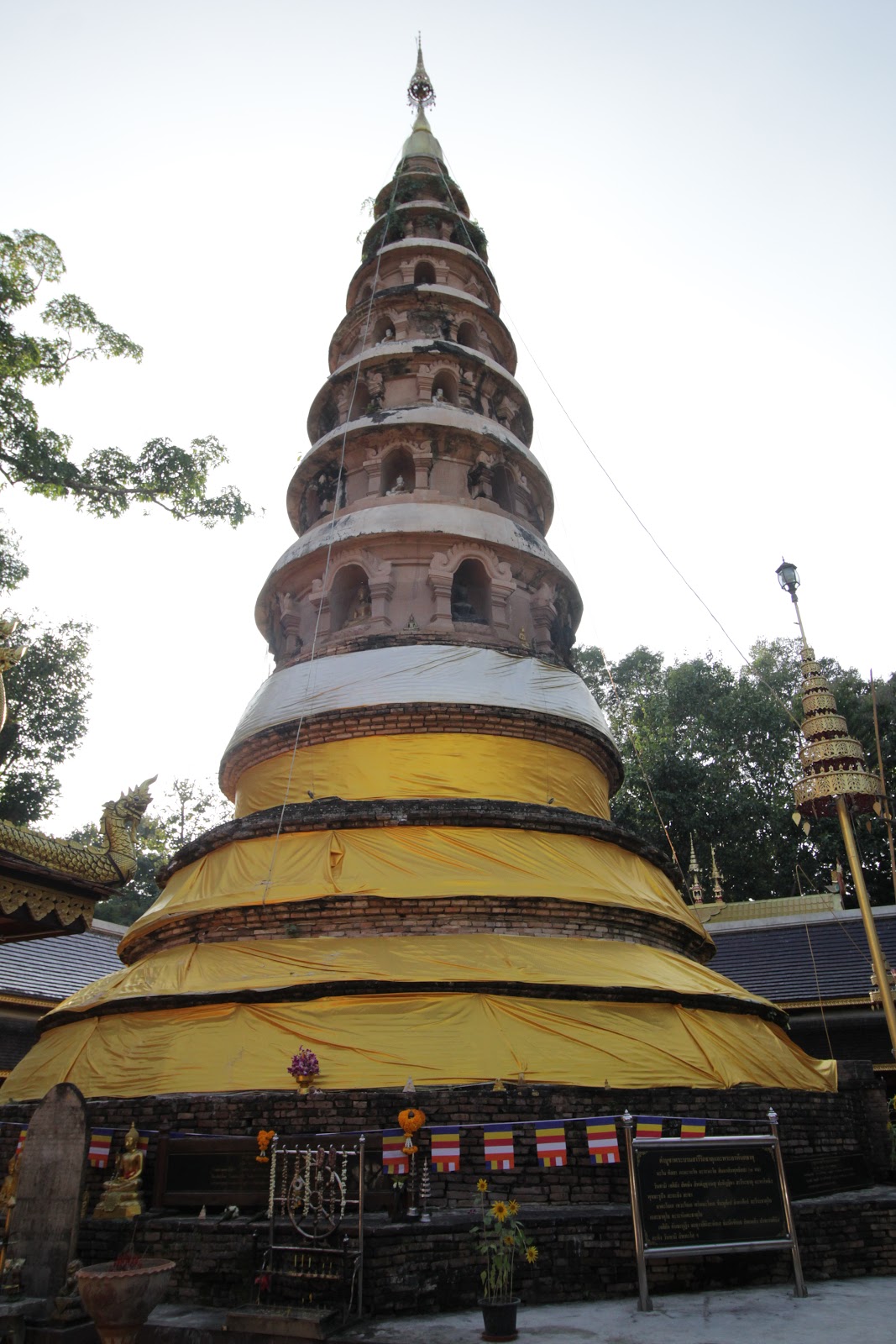
Il mito fondativo racconta che il re Phaya Yot Chiang Rai decise di fondare un monastero per fare ammenda dopo aver vendicato l'omicido del padre. Il luogo fu scelto grazie alle indicazioni di un monaco rispetto a delle reliquie sepolte in zona, infatti aveva notato dei raggi di luce emanati alla base di un albero. Il re decise che il luogo preciso sarebbe stato stabilito laddove si fosse fermato il suo elefante, così fu. Nel punto dove si era fermato l'animale venne ritrovato un dente all'interno di un contenitore e si decise di costruire sul luogo uno stupa dalla particolare architettura circolare, con vari livelli in cui sono collocate delle nicchie con delle statue.
Lo stupa è ancora oggi visibile anche se ha subito dei restauri soprattutto nella parte finale. Il giorno della consacrazione il re portò la reliquia in processione ed essa di nuovo emanò dei raggi definiti lunari.
Successivamente il tempio conobbe un'epoca di declino e rimase deserto, soprattutto venne abbandonato nel corso della seconda guerra mondiale, quando nella zona si stabilirono i soldati dell'esercito giapponese e la popolazione locale si allontanò. Tutte le strutture subirono danni e anche le immagini del Buddha, fortunatamente la pietra con l'iscrizione della sua fondazione era stata preventivamente sepolta. Nel 1941 un monaco prese accordi e trasferì l'immagine principale del Buddha presso il wat phra singh, in centro città. 
Terminata la guerra la popolazione tornò ad abitare nei pressi del tempio, ma non c'era un abate, molti monaci vi risiedevano per un po' di tempo e poi se ne andavano. Nel 1971 iniziarono i lavori di ricostruzione, nel 1974 Phrakhru Pipatkanapibarn, abate del Wat Muang Mang e docente capo della scuola di meditazione decise di trasferirsi al wat ram poeng. Egli fece appello a tutta la popolazione affinchè contribuisse alla riqualificazione del tempio destinandolo a luogo per la pratica e l'insegnamento della meditazione. La risposta fu tale che già nel 1975 il tempio iniziò la sua attività di centro di meditazione sotto la guida di Phrakhru Pipatkanapibarn, che ne era diventato l'abate. 

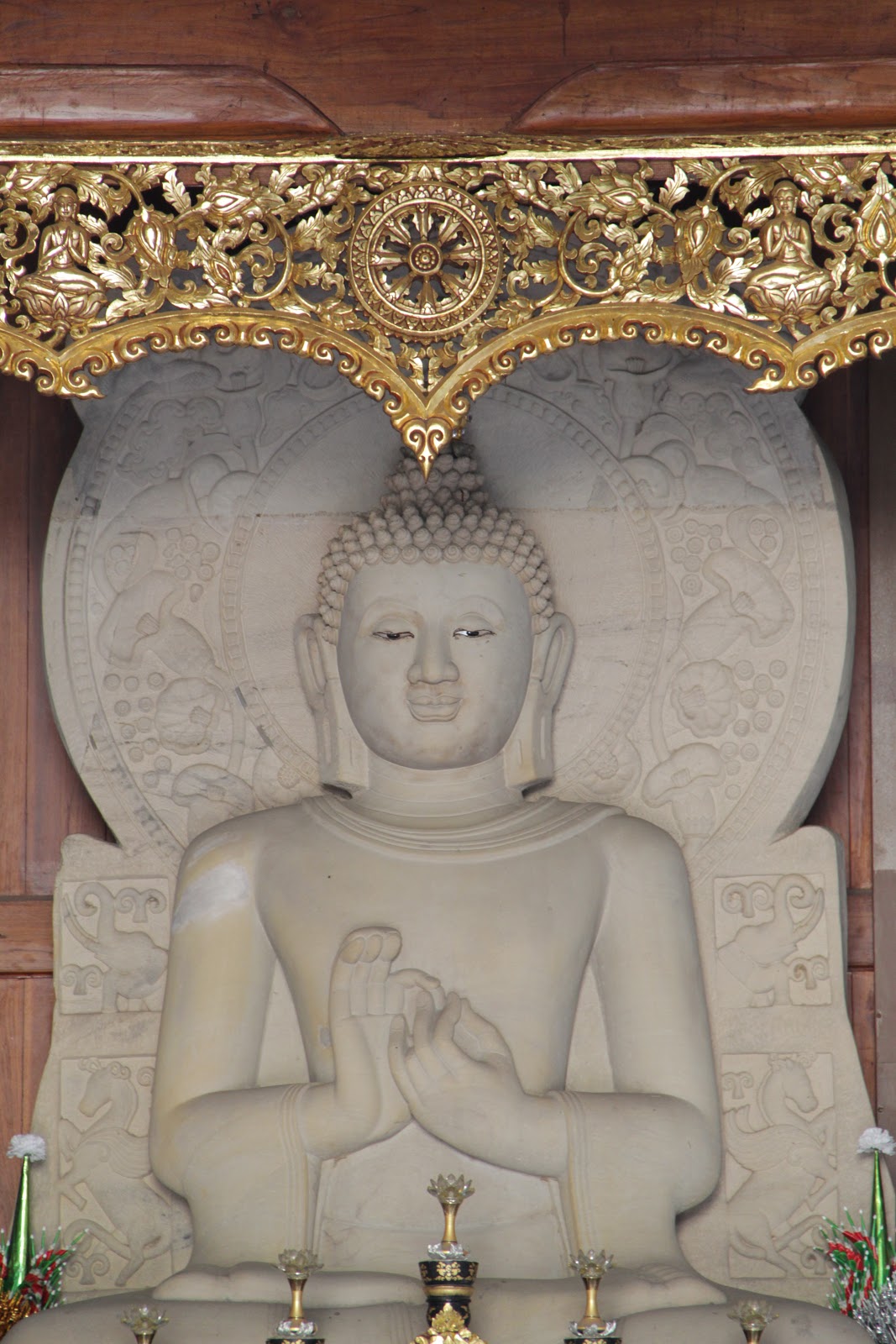
L'immagine del Buddha collocata nella Ubosot ha tra i 700 e 800 anni e fu donata al tempio dal sergente Prayoot Tripian il 22 marzo del 1975.

Attualmente il tempio si presenta in tutto lo splendore della ubosot o sala delle ordinazioni e della wihan, la  sala assembleare, interamente in teak.
La ubosot ha la caratteristica di non avere pareti, a parte quella di fondo, ed il suo perimetro ai lati è affiancato da due portici in legno. Come già scritto sopra qui è collocata l'immagine in pietra del Buddha, in alto rilievo, ritratto mentre esegue il dharmachakra-mudrā, l'atto di mettere in moto la ruota della legge.

La wihan è completamente in legno e con le pareti laterali, la struttura è molto elegante ed invita al silenzio e alla meditazione.
Sul retro è presente una torre campanaria molto colorata e un edificio molto recente dedicato alla biblioteca dove sono conservati i testi della tradizione in pali, ma anche testi moderni sul buddismo in lingua inglese.


Da ultimo rimarrete ammirati dall'antico stupa, rimasto quasi intatto e dalla forma molto particolare già descritta sopra. Un portico in legno delimita l'area circostante. 
Non mi sono avvicinata molto a questi spazi in quanto vi erano diverse donne che stavano meditando camminando. Il tempio infatti è un importante centro dove vengono svolti ritiri vipassana anche per stranieri. Nel caso siate interessati potete consultare il sito web del tempio: http://www.watrampoeng.com/


[ENGLISH VERSION]


By pure chance I came across this really beautiful temple, to then discover its long history and its current activity as a center for vipassana retreats.


The wat ram poeng is located in the area of Pong Noi, south-west of Chiang Mai, an area in full development at the foot of the doi Suthep, practically ten minutes by scooter from my home.


Although now in an urbanized area the temple seems to be immersed in silence and isolated, most likely when it was founded the context had to be quite different, its foundation dates back to 1492 of the Christian era. There is also a stone where are reported the precise data of its foundation occurred at 08:20 in the morning of the third day of the seventh lunar month, in the year of the rat. 

The founding myth tells that King Phaya Yot Chiang Rai decided to found a monastery to make amends after avenging the murder of his father. The place was chosen thanks to the indications of a monk with regard to some relics buried in the area, in fact he had noticed the rays of light emanating from the base of a tree. The king decided that the exact place would be determined if his elephant had stopped, so it was. At the point where the animal had stopped, a tooth was found inside a container and it was decided to build on the spot a stupa with a particular circular architecture, with various levels in which there are niches with statues. The stupa is still visible today even though it has undergone restoration, especially in the final part. On the day of the consecration the king carried the relic in procession and it again emanated rays defined lunar.

Later the temple experienced a period of decline and remained deserted, especially was abandoned during the Second World War, when the soldiers of the Japanese army settled in the area and the local population moved away. All the structures suffered damage and also the images of the Buddha, fortunately the stone with the inscription of its foundation had been previously buried. In 1941 a monk made arrangements and transferred the main image of the Buddha to the wat phra singh, in the city center. 

After the war the population returned to live near the temple, but there was no abbot, many monks resided there for a while and then left. In 1971 the reconstruction works began, in 1974 Phrakhru Pipatkanapibarn, abbot of Wat Muang Mang and head teacher of the school of meditation decided to move to wat ram poeng. He appealed to the entire population to contribute to the redevelopment of the temple as a place for the practice and teaching of meditation. The answer was such that already in 1975 the temple began its activity as a meditation center under the guidance of Phrakhru Pipatkanapibarn, who had become the abbot. 


The image of the Buddha located in Ubosot is between 700 and 800 years old and was donated to the temple by Sergeant Prayoot Tripian on March 22, 1975.


Currently the temple is presented in all the splendor of the ubosot or room of ordinations and the wihan, the assembly room, entirely in teak. The ubosot has the characteristic of having no walls, apart from the bottom one, and its perimeter at the sides is flanked by two wooden porches.
As already written above, here is placed the stone image of the Buddha, in high relief, portrayed while performing the dharmachakra-mudrā, the act of setting in motion the wheel of law.


The wihan is completely made of wood and with the side walls, the structure is very elegant and invites to silence and meditation.
On the back there is a very colorful bell tower and a very recent building dedicated to the library where the traditional texts in pali language are stored, but also modern texts on Buddhism in English.


Finally, you will be amazed by the ancient stupa, which has remained almost intact and has a very particular shape already described above. A wooden portico delimits the surrounding area. I did not get very close to these spaces because there were several women who were meditating walking. The temple is in fact an important center where vipassana retreats are carried out even for foreigners. In case you are interested you can consult the temple website: wat ram poeng 


mercoledì 16 ottobre 2019

IL TEMPIO THAI - BREVI E APPROSSIMATIVE INFORMAZIONI PER NON FARE BRUTTA FIGURA - THE THAI TEMPLE - SHORT AND APPROXIMATE INFORMATION TO MAKE A GOOD IMPRESSION

[SCROLL DOWN FOR ENGLISH VERSION]


Per chi è nato e cresciuto in una realtà occidentale, prevalentemente di cultura cristiana, magari anche di corrente cattolica, è sicuramente difficile decodificare tuttto quello che è presente all'interno di un tempio thailandese. Sicuramente siamo portati a fare una grande confusione soprattutto perchè ci troviamo costretti a descrivere con il nostro vocabolario quello che vediamo e che spesso non ha una corrispondenza nella nostra cultura.

Prima di proseguire devo fare una breve premessa. Quando ero una giovane studentessa di Storia Medievale, come tutti i colleghi di studi, ero consapevole che si poteva incorrere in una bocciatura nel caso avessimo usato in modo erroneo i termini monastero e convento o confuso i loro abitanti appunto monaci e monache o frati e suore. Nel senso che i monaci abitano nei monasteri che seguono regole più o meno rigide di clausura, mentre i frati e le suore abitano nei conventi e non sono in clausura. Tutto questo per dire che quando parliamo di monaci e monasteri buddisti secondo me utilizziamo termini sbagliati perchè in realtà la loro regola è più simile a quella dei nostri frati. Ma essendo ormai così diffuso tale errore mi adeguero' anche io all'uso corrente e nel descrivere le strutture conventuali buddiste e i loro abitanti utilizzero' i termini monasteri e monaci.


Un tempio buddista è sempre costituito da più edifici, alcuni dedicati al culto e altri ad alloggiare i monaci. Una certa importanza è data all'ingresso del compound del tempio. A volte si tratta di lunghe scalinate, i cui lati sono protetti da figure mitologiche, Naga, draghi, e altri. 


Altre volte l'ingresso è un arco sormontato da un vero e proprio edificio in miniatura definito prasat. In ogni caso deve essere ben delineato  il passaggio dal mondo laico allo spazio sacro, quest'ultimo è protetto dai mostri posti ai lati dell'ingresso per impedire ai demoni di entrare. E' noto infatti che i templi sono off-limits per i fantasmi.

Una volta entrati nel tempio di solito troviamo almento tre edifici: la wihan (sala dell'assemblea), la bot o ubosot (sala delle ordinazioni) e lo stupa (sacrario).


WIHAN
La wihan è l'edificio dedicato alla maggior parte delle funzioni che si svolgono all'interno del tempio, preghiere, canti e letture, assemblee della comunità e interazioni tra monaci e fedeli in occasione di particolari festività, quando vengono pronunciati dei sermoni. All'interno di un tempio possiamo trovare anche più wihan di diverse dimensioni. 
Tale edificio è costruito lungo un asse est-ovest in modo che la facciata sia rivolta verso il sole nascente.
La wihan simboleggia l'imbarcazione sacra che attraversa l'oceano del Samsara (il ciclo infinito delle rinascite). 
BOT O UBOSOT


La bot o ubosot è molto simile alla wihan, ma è sempre singola. Nel nord della Thailandia spesso è più piccola,  collocata dietro e sulla sinistra rispetto alla wihan. Questo edificio è utilizzato per le ordinazioni dei monaci e per ogni rito riguardante la diciplina monastica. A volte la bot può essere chiusa, in particolare nelle aree rurali, in alcuni casi l'ingresso è comunque vietato alle donne o ai laici.

La sala delle ordinazioni è riconoscibile da otto elementi in pietra (bai sema), posti al livello del terreno per delemitare l'area sacra nei suoi punti cardinali e sub-cardinali, in corrispondenza sono seppellite delle sfere in pietra rivestite di foglie d'oro (luk nimit), una nona sfera è sepolta al centro della bot. Nessuno devono camminare o puntare i propri piedi sopra una luk nimit.


STUPA (CHEDI)

La terza immancabile struttura è lo stupa o chedi, monumento commemorativo del Buddha. Simbolizza il Monte Meru, centro cosmico dell'universo buddista.
Lo stupa centrale è la struttura più importante del tempio, nel caso contenga una reliquia del Buddha il tempio acquisisce il titolo phra that, nel nord sono poco più di venti i templi con questo titolo, il pù noto è sicuramente il wat phratat doi suthep sulla montagna che domina Chiang Mai.


[ENGLISH VERSION]
For those who were born and raised in a western reality, mainly of Christian culture, perhaps also of Catholic current, it is certainly difficult to decode everything that is present within a Thai temple. Surely we are led to make a great deal of confusion, especially because we are forced to describe with our vocabulary what we see and often does not have a correspondence in our culture.

Before continuing I must briefly give an introduction. When I was a young student of Medieval History, like all colleagues of studies, I was aware that we could have a failure if we used the terms monastery and convent incorrectly or confused their inhabitants precisely monks and nuns or monks and nuns. In the sense that the monks live in monasteries that follow more or less strict rules of clausura, while the friars and nuns live in the convents and are not in clausura. All this to say that when we speak of Buddhist monks and monasteries in my opinion we use the wrong terms because in reality their rule is more similar to that of our friars. But since this error is now so widespread, I too will adapt to current use and in describing Buddhist convent structures and their inhabitants will use the terms monasteries and monks.

A Buddhist temple is always made up of several buildings, some dedicated to worship and others to house the monks. A particular importance is given to the entrance of the temple compound. Sometimes they are long staircases, whose sides are protected by mythological figures, Naga, dragons, and others.

Other times the entrance is an arch surmounted by a real miniature building called prasat. In any case, the passage from the secular world to the sacred space must be well defined, the latter is protected by the monsters placed at the sides of the entrance to prevent demons from entering. It is well known that temples are off-limits to ghosts.

Once in the temple we usually find at least three buildings: the wihan (assembly hall), the bot or ubosot (ordination hall) and the stupa (shrine).

WIHAN

The wihan is the building dedicated to most of the functions that take place within the temple, prayers, songs and readings, community assemblies and interactions between monks and faithful during particular holidays, when sermons are given. Inside a temple we can also find several wihans of different sizes.
This building is built along an east-west axis so that the facade faces the rising sun.
The wihan symbolizes the sacred boat that crosses the ocean of Samsara (the endless cycle of rebirths).

BOT OR UBOSOT
The bot or ubosot is very similar to the wihan, but it is always single. In northern Thailand it is often smaller, located behind and to the left of the wihan. This building is used for the ordination of monks and for any ritual concerning monastic discipline. Sometimes the bot can be closed, especially in rural areas, in some cases the entrance is however forbidden to women or lay people.

The ordination room is recognizable by eight stone elements (bai sema), placed at ground level to delimit the sacred area in its cardinal and sub-cardinal points, in correspondence are buried stone spheres covered with gold leaves (luk nimit), a ninth sphere is buried in the center of the bot. No one should walk or point their feet at a luk nimit.

STUPA

The third structure that is not to be missed is the stupa or chedi, a memorial to the Buddha. It symbolizes Mount Meru, the cosmic center of the Buddhist universe.
The central stupa is the most important structure of the temple, in case it contains a relic of the Buddha the temple acquires the title phra that, in the north there are just over twenty temples with this title, the best known is definitely the wat phratat doi suthep on the mountain that dominates Chiang Mai.

MONACHESIMO FEMMINILE: LA GOCCIA CHE SCAVA LA ROCCIA - FEMININE MONASTICISM: THE DROP THAT HOLDS THE ROCK

  [SCROLL FOR ENGLISH] In Thailandia le bikkhhuni esistono e stanno crescendo. Il turista medio occidentale quando immagina o ricorda un vi...